Monday, November 27, 2023

Universities the hub for the future of Malaysian Sports


Universities the hub for the future of Malaysian Sports

The myth that Universities are a graveyard of sports is long gone and Universities these days should be embraced wholly as part and parcel of the Malaysian sports agenda to seek excellence by the Ministry of Youth and Sports.

Even more so because Universities come under the Ministry of Higher Education (MOHE), and it will be more feasible and rewarding with the Sports Ministry and the former, working hand in hand, under government umbrella.

Even if the collaboration exists, it certainly can be enhanced further.

The National Sports Council (NSC) and National Sports Institute (NSI), should be also working hand-in-hand and engaging the Universities more closely, instead of them trying to be a ‘stand alone’ and assume the role of ‘Godfathers’ of Malaysian sports.

The perceptions of the Universities as the burial place of an athlete’s career are an outdated view and is no longer relevant.

The specific role of the University has been stated in the National Sports Policy to provide more opportunities for athletes to continue their studies at higher Education Institutions and they can be more active and highlight their potential as athletes even while at the University.

Following on from that, the Higher Education Institution Sports Policy 2009 exists with the aim to produce “The Thinking Athlete”.
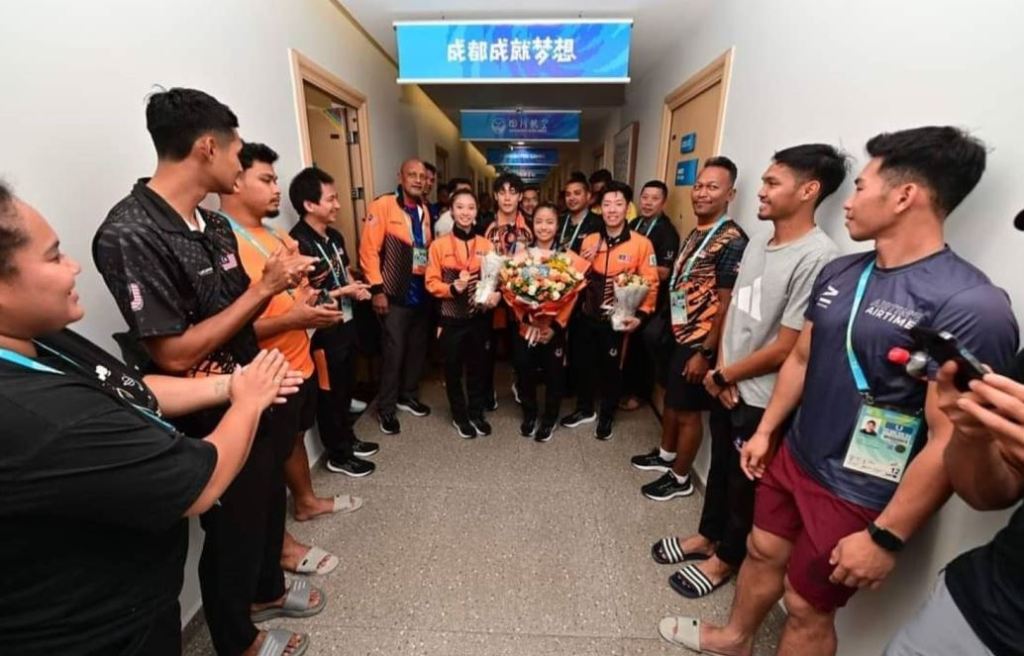
Datuk Dr Pekan Ramli together with the Malaysian contingent and wushu athlete Tammy who made national history by winning the first gold medal at the Universiade Chengdu in 38 years.

Thirty percent of the athletes who represent the country come from the Universities. The existence of a specific policy on sports development at the University level has witnessed a drastic development and since that more than twenty public and private higher education institutions offering more than forty sports study programs from Diploma level to Doctor of Philosophy in fields related to sports science and sports management exists.

This prompted public and private higher education institutions now race to do scouting to get junior athletes and state athletes as well as student athletes from Malaysian sports schools, to offer them the opportunity to continue their studies at the university and at the same time continue to be active in sports.

All this was presented by Datuk Dr Pekan Ramli, the Deputy Under Secretary, Sport Section, Strategic Planning Department (Policy), Ministry of Higher Education in his paper ‘development of sports in universities’.

Pekan, a former broadcast journalist, who is passionate about Universities Sports, strongly believes that the Universities is the way forward to see Malaysian sports reach a higher level at the international level.

But whether the authorities who manage sports in the country see that way or are keen to engage the universities, is a question to be answered.

Infact, besides the sports authorities, National Sports Associations should also engage closely with the universities.

Today, sports has become an integral part of the university system. There are inter-university games, inter-college and higher learning institution games and inter-university leagues for football, hockey, squash and bowling, among others.

University students also compete in the Asean and World Universities Games (currently ongoing in Chengdu, China) and many of our national athletes are products of the universities.

Wushu exponent 22-year-old Tammy Tan created sporting history by winning the country’s first ever gold medal in the World University Games in Chengdu, China, ending a 38-year gold medal drought in the Games, while former gymnast Mandy Cebelle Chen was the first to make podium at the Games winning a bronze in the tajiquan discipline in wushu, while swimmer Bryan Leong and athlete Umar Osman set national records.

Thirteen years ago, then Minister of Higher Education (KPT), Datuk Seri Mohd Khaled Nordin announced that RM10 million was allocated to higher learning institutions under its programme to develop sports among undergraduates.

Sports Excellence Centres at universities nationwide was already in place and the funds allocated was to develop selected sports in a systematic method and provide further education for students athletes in order to create & quot; thinking athletes & quot.

Datuk Dr Pekan Ramli together with the Malaysian contingent and wushu athlete Tammy who made national history by winning the first gold medal at the Universiade Chengdu in 38 years.

Eight universities had already been selected as Sports Excellence Centres which each focusing on a specific sport.

The eight Sports Excellence Centres are Universiti Malaya (netball), Universiti Sains Malaysia (swimming), Universiti Kebangsaan Malaysia (cricket), Universiti Putra Malaysia (rugby), Universiti Teknologi Malaysia (rowing), Universiti Teknologi Mara (football), Universiti Utara Malaysia (golf) and Universiti Malaysia Sabah (taekwondo).

Besides the eight universities, other institutions which had the potential to become centres for sporting excellence had also been given the status of Focus Sport Centre.

There were 18 higher-learning institutions with the Focus Sport Centre status Out of the RM10 million allocated by the ministry for sports development that year, about RM7.2 million was for the Sports Excellence Centres and RM3.6 million for the Focus Sport Centres.

Maybe and update on the status could be given and whether the emphasis has grown.

However, whether a proper study was made before naming the sports to be focused in each particular higher learning institution was made and raised then.iu7 Hope it has been addressed after all these years.

I know for a fact that in 2006 an in-depth study was done by Prof Rabindarjeet Singh who was then with the National Institute of Sports (NSI) on sports adoption by Universities.

A report was complied and it contained the sports to be adopted by the respective University based on the study made which involved available manpower, equipment facilities which were available and what needed to be purchased and manpower to be trained for the University to be effective.

The development of high-performance sports at higher education institutions has seen more and more university athletes now able to represent the country and contribute to the success of the national contingent at regional and international championships.

University athletes representing the country has also been consistently achieved at sporting events such as the Sea Games, Commonwealth Games, Asian Games and the Olympic Games. University athletes are now among the main contributors to the medal collection for the national contingent at various sports games.

To ensure the continued success of athletes and as a strong encouragement to them, KPT also provides sports scholarships for outstanding athletes every year.

Up to now, almost two thousand outstanding university athletes have received the scholarship.

Even some public and private higher education institutions have also given privileges by giving them their own scholarships and exempting student-athletes from tuition fees and college accommodations fees.

Although there is no specific study or empirical study to show the connection between the privileges they receive and the improvement in the performance of these student athletes, MOHE is confident that the success of university student

athletes in various sports games when representing the country has a special correlation with the awarding of the scholarship.

In order to ensure that the careers of student athletes at the university continue and not only active in sports seasonally or once a year during the semester break only, but a massive transformation has also been carried out by the MOHE by creating university level sports tournaments more organized and with systematic manner and running throughout the year.

Various university-level sports tournament has now been held with the concept of ‘NCAA’ by having several circuits and must ended with the grand final along the year for several championship such as Varsity Track and Field, Varsity Sepak Takraw League, Varsity Futsal League, Varsity Softball League and several other sports.

However, the major role played by MOHE and the university in developing the sports higher performance of student athletes as higher education institutions in providing more guaranteed future opportunities for student athletes is still seen as a side character to produce high performance sports athletes in the country.

In fact, the sports development agenda at university is often left out of the sports calendar of National Sports Associations (NSA) and the NSC.

Although various initiatives have been made to close this collaboration, it has not yet been integrated. There is still the conflicts of interests and individual egos in some NSA towards the issue of ownership of the athletes to represent country to participate in university sports games at international level such as Asean University Games (AUG), World University Games or Universiade and World University Championship (WUC).

It is about time, that universities are allowed to play a more prominent role in the national sports agenda.

Universities are no longer the graveyard of sports. A rethink is urgently needed and long over due. One body cannot be handling 20 over sports. 

In fact, the schools have now become the graveyard of sports, and this is another issue which needs to be addressed urgently.

A topic for discussion in the coming columns.
Is it a truly Malaysian Merdeka Day?


Is it a truly Malaysian Merdeka 

Day?

Today as we celebrate our 66th year of independence, I believe we have celebrated better independence days in the earlier years, when we were truly Malaysians celebrating as one Malaysians.

Today, although the nation is considered young compared to many others who had gained their independence longer, the Statistics Department has recorded 2.1 million foreigners working in various sectors in Malaysia up to June 2022.

Close to two million were recorded in 2019 and 2.1 million in 2020, while unofficial estimates of undocumented or irregular migrants range from 1.2 to 3.5 million – thus making Malaysia one of the largest migrant-receiving country in Southeast Asia.

While we are grateful to the foreigners who have helped the nation grow in various sectors, including providing domestic help to the growing population of working parents.

But the question, why is the local population shying away from jobs done by foreign workers?

While generally the unemployment rate in the country has generally dropped – Malaysia’s unemployment rate for 2022 was 3.73%, a 0.32% decline from 2021. Malaysia unemployment rate for 2021 was 4.05%, a 0.49% decline from 2020 – but the rise in foreign workers is alarming.

What is even more disturbing is that sports has seen a sharp increase in foreigners being given citizenship status and the influx of heritage players – a heritage player is one who has ancestral connections with the country that he wishes to play for – especially in football.

While many will claim that sports has no borders these days, but is it right for a young nation like Malaysia to follow the path?

Are we proud to see national teams with foreign players – be it heritage or foreign players granted citizenship – standing looking dumbfounded when the national anthem is played?

It was a delight and I was proud to see the national hockey team – made up of true Malaysian from the length and breath of the country, including East Malaysians – singing the national anthem with pride, passion and gusto.

Malaysia’s population maybe small at 34.3 million, as compared to many nations, but we have the three main groups – Malays, Chinese and Indians – and then we have the Eurasians and Punjabis and the other indigenous groups like Orang Asli, Iban, Murut, Batak, Kelabit, Kedayan Tausug (people ethnic group belonging to both the Philippines and Malaysia) Bidayuh, Kadazan Dusun, Kayan, Penan, Negrito, Minangkabau, Bugis, Kenyah and Javanese to name some.

This is already an international community living in one nation and with such diversity, is it a wonder that our sports fraternity cannot assemble a formidable team with each ethnic group with their strength.

This combination of a mixed team was what brought us glory in sports like football (qualified for two Olympics – Munich and Moscow), badminton (stood tall in Thomas Cup competition), sepak takraw (ruled the region), athletics (qualified on merit to Olympics and even reached the semifinals), and many other sports.

Only the sports of hockey seems to keep to the traditional ways and doing well too.

Being a Malaysian, take a walk to the heart of the city at Petaling Street, Sentral Market and Jalan Silang, today being a public holiday, and you true Malaysians will be the ‘foreigners’ among the sea of Indonesians, Filipinos, Bangladeshis, Pakistanis, Indians, Myanmars, Vietnamese, Cambodians and others.

Is this how we want to remember celebrating our ‘Merdeka Day’. Are we really independent?

We are not denying that the country still need foreign workers in various sectors such as construction, plantation, manufacturing and domestic.

But sports is one area, we can do away with them.

At the same time, we also need to attract locals to work in the plantation or construction industry by providing better facilities so as to reduce the country’s dependence on foreign labour.

We also need to look into the National Sports Policy and a re-look into the National Sports Vision 2030 (VSN2030) launched by (2020) former Sports Minister and then Prime Minister, Datuk Seri Ismail Sabri Yaakob, which was to provide a new direction and plan for the development of national sports that is comprehensively and collectively mapped for a period of 10 years.

Or is this policy still in place because Malaysian sports policies change with every new Sports Minister, as they try to leave behind their own legacy.

How many Sports Ministers have we had in this five-year term?

Besides, the Sports Ministry is also torn between promoting sports for all and paying attention to excellence sports and the National Sports Council also needs to revisit it’s real role in development and promoting sports excellence.

There is lot to be set right for Malaysian sports before it achieves its true potential and today being the ‘Merdeka Day’s, would be a perfect day to start putting things right, with no personal agenda or gain in mind, but for sports to emerge the winners.

Maybe far too much to ask, because we seen the ills rise again over and over, past mistakes repeated and tainted by officials who have personal agendas.

All we can do and pray, is hope things will change in the name of sports and fairplay will prevail. After all, sports is suppose to be pure!

Happy Merdeka Day as we try to live up to this year’s thyme – Tekad Perpaduan, Penuhi Harapan (Determined Unity, Filled with Hope).

Spot and support children with talent, early


Spot and support children with talent, early

Children of ex-international athletes and of parents, who take special interest to develop their children to excel in sports and show potential, should be another target group of sport administrators in the country and private sectors to give financial aid.

Of late there has been a rising number of cases of athletes of the above group who have been struggling to get financial aid for studies and training for their children to pursue their dreams and do the nation proud.

Yes, there are many ex-international athletes and parents, who would rather encourage their children to pursue their studies alone, rather than divide their attention with sports.

But those ex-international athletes and parents who have gone the path to encourage their children to pursue sports, especially when the parents and both international athletes and their genes, plays a great part in their children excelling too.

Shereen.

Take for instance ex-international athletes, Samson Vallabouy and Josephine Mary, whose daughter Shereen’s struggle to find sponsors to finance her studies and training in the United States and the parents made huge sacrifices to get her off ground, before getting Better Malaysia Foundation to support her through Tan Sri Vincent Tan’s foundation (BMF) from May 2022 until December 2023 and went on to set records after records.

What saddens me another athlete who would have done equally well – her older sister Jocelyn – whom we lost at the Bukit Jalil Sports School (BJSS), all because this girl from a small town Ipoh, could not cope with the city life style and returned home.

When Shereen joined BJSS later, Jocelyn wanted to return to after attaining good SPM results as her sister was there to accompany her, but she was denied entry because of some bureaucratic procedure.

If only Jocelyn, a State athlete, had returned to BJSS, probably we will be celebrating two athletes instead of just Shereen!

Shereen is in Florida since June after her last semester at Winona State University for an internship and further training under coach Derrick White.

She ran a blistering 23.33s at the Ed Murphey Classic at Memphis last week to erase G. Shanti’s national record of 23.37, registered at the Asian Championships in Fukuoka, Japan, in 1998. Shereen’s previous was 23.42, set in Jacksonville last month.

Earlier, Shereen had finished on the podium of the women’s 400m with a time of 51.99.

On April 16, Shereen broke the national 400m record held by the late Rabia Abdul Salam with a time of 51.80s at the 63rd Annual Mt SAC Relays Athletics Championship, California, USA.

Shereen had previously broken the 400m indoor national record four times, with the last one helping her to win a gold medal at the National Collegiate Athletic Association (NCAA) Division II Indoor Track and Field Championships in Virginia Beach, Virginia last May.

The 25-year-old Shereen now holds three national records – women’s 200m, women’s 400m (51.80) and indoor (52.27).

Bryan Leong Xin Ren.

Another case I wish to high limelight, is swimmer Bryan Leong Xin Ren, which the world of swimming is currently abuzz with his achievements.

The 20-year-old recently garnered widespread attention by setting a new national record on the very first day of the swimming events at the FISU Games held in Chengdu.

Bryan clocked an impressive 24.35 seconds in the men’s 50 meters butterfly, edging the Malaysian national record by a mere 0.03 seconds. He is now revered as a triple national record holder.

Beyond his latest feat, he possesses the records for the 50 meters freestyle and the 100 meters butterfly. Bryan’s journey is as intriguing as his achievements.

Currently, he’s based in London, diligently pursuing his bachelor’s studies in the intricate fields of neuroscience and psychology at the prestigious King’s College London and also he’s refining his aquatic prowess with the Chelsea and Westminster swimming club.

British coach Lisa Bates, renowned in the swimming circuit, is mentoring and guiding him.

His parents, Leong KS and Nancy Hon, are no international athletes, but just passionate about sports and thus supported their son’s love for swimming.

Leong and Nancy who run a contractor business, supported their only son, but when it got expensive especially to finance his studies, several applications to private sectors and foundations were sent and after some interviews, all were with negative replies.

He is still financed by his parents despite difficulties.

Before that, Bryan as a 15-year-old who broke Olympic champion Joseph Schooling’s age group tournament record, was facing a bleak future after he was told to wait for one year if he wished to represent other states after initially refusing written permission from the Selangor Amateur Swimming Association (PRAS).

After media reported on the matter, he was finally allowed to swim and represent Kuala Lumpur where he had moved to join an international school. Then, came the disappointment of being left out of Sukma Games.

Are these the tribulations potential athletes in Malaysia have to go through?

Those who withstand the pressure and obstacles, strive in the end. But what about the many who crumble, are weak or simply just fed up with the politics, unfairness and lack of support, who quit?

Aaliyah Hanifah Yoong.

Another example would be water skier Aaliyah Hanifah Yoong. She too had her struggles in the early days, but was lucky her father Hanifah Yoong, a former motor racer and, mother Nozie supported her, while getting assistance from equipment sponsors and corporate bodies and National Sports Council, before a foundation came to her aid to assist her to further her studies and training.

Aaliyah was a little luckier, but still had to go through struggles before being recognised.

Aaliyah Hanifah Yoong.

Question here is how many potential athletes have we lost because we took our time to support potential athletes from this ‘distinguished’ group?

I personally know of athlete parents and parents, whose children who had potential to excel, but gave up because of lack of support, politics, unfairness and marginalised.

It is most often the parent who is the first person to introduce a child to sports and parental involvement can affect whether a child enjoys the experience or not. 

The more positive and fun the parents attitude is about playing sports, the more their child will have interest.

We all know there are some parents that are over the top – but the majority of them are actually part of the solution, not part of the problem. In fact, without parent involvement, there is no way that youth sports leagues can function.

Even more so of parents who have been athletes because they have the genes and understand the sport better and the sacrifices needed.

Swimming, tenpin bowling, football, athletics and badminton are among the sports we have many parents and parents who were athletes involved.

It is about time, we emphasis and target these groups to look for our future champions rather than hire foreign sportsmen and women and offer them citizenship eventually.

The importance, support and role of parental involvement in youth sports certainly cannot be overlooked.

PARENTS OF POOR CHILDREN SHORTCHANGED?


PARENTS OF POOR CHILDREN SHORTCHANGED?

Youth and Sports Minister Hannah Yeoh’s recent announcement in Kota Kinabalu, that parents who send their children for sports training or undergo such activity themselves might qualify for personal tax relief starting next year, is a welcome move but was it well thought off?

The proposal under Budget 2024 had been presented to the Finance Ministry.

While it was well received by parents who have played an active role in the development of their children in the sports of their choice, with extra and special coaching programmes and training, it has left many wondering what happens to children from poorer families.

Poorer families naturally do not have the means to send their children for individual personalised training outside the school curriculum.

Maybe incentives like subsidies for poor parents who choose to engage coaches to coach their children, should be considered to have a wider base.

Or does it mean that children from poor parents are going to be ruled out from excelling in sports to higher levels or they just have to depend on the schools’ sports programme in place and hopefully rise from there.

Maybe we are resigned to the fact that we are just going to depend on children of the well-to-do families who can offer their children specialised training for our future ‘stars’.

Next question is whether Sabah was the right place to announce the ‘tax relief’, as a majority of the population are still in the low bracket of income. How would this benefit the people  of Sabah?

Advertisement

The Minister had made the announcement after launching the Sabah Sports Industry Expo 2023 this week.

 She had said that the move could be among the ways to encourage parents to send their kids for training, which would in turn help with sports development in the country.

How can poor parents afford to send their children for extra training on their own?

Currently tax relief is only given for the purchase of sports equipment.

The proposed tax relief will also cover parents undergo training themselves and qualify with the aim to indirectly encourage people to practise a healthy lifestyle, besides getting children to be involved in sports from a young age.

This proposal was made in view of wanting the sports industry to develop. 

The announcement was made in line with the fact that the sports industry contributed some RM14bil, or 0.9%, to the nation’s gross domestic product.

All well and good, but a serious thought has to be given to sports development in schools and for all, instead of ‘select’ groups.

Yes, there are various programmes in place, but it has to be seriously reviewed by the Ministry of Sports with the Ministry of Education.

The Sports Ministry and Education Ministry,  without doubt have to work hand-in-hand and not in isolation or have their own programmes.

Already it is fast being said that ‘Schools are the graveyard of sports.’

It used to be ‘Universities are the graveyards of sports’ but that has changed in recent years as Universities are big into sports these days.

Today, sports has become an integral part of the university system. There are inter-university games, inter-college and higher learning institution games and inter-university leagues for football, hockey, squash and bowling, among others.

University students also compete in the Asean and World Universities Games and many of our national athletes are products of the universities.

But while schools have been contributors too, but much more can be expected from them with better involvement with better programmes as they are the grassroot where development starts.

Sadly, schools, which were the nursery for sports in the country, are slowly but surely losing their relevance.

Yes, we have national sports schools and sports excellence schools in the various states, while the Ministry of Education has leagues for football and some other sports. True, the Malaysian Schools Sports Council has programmes for 24 sports for Under-12, Under-15 and Under-18. However, these only benefit a select group of students.

Efforts have to be made to build a wider base and to cater for late bloomers, and this can only be achieved through mass participation at national schools, something that is slowly disappearing.

Even the ‘1 student 1 sport’ programme has its shortcomings, with students not allowed to participate in the sport of their choice. Or there are not enough  qualified teachers to groom them and the hours dedicated to sports activity are limited.

Gone are the days when we had inter-class and inter-house games before the school team was selected for various sports. The school athletics and swimming meets were grand affairs.

Teachers, who were a dedicated lot, played a key role in the development of sports in schools.

Without any discrimination intended, today, almost 70% of school teachers are women and expecting them to chart the future of Malaysian sports is probably asking for the impossible. 

Physical educations periods are now divided into physical session on field and health classroom sessions. Each session lasting 30 minutes, sees two sessions of PE on field and two classroom sessions.

 The 1 student 1 sport programme is held once week after school hours for two hour to three hours and only for 12 weeks for the number of sports decided by the school (most schools have six to eight sports) culminating with ‘Hari Sukan’ for all the sports (competition).

There are selection for various sports by schools for Inter-District tournament and they train separately for a few weeks before competition. The competition itself is held on a carnival basis over three or four days.

At the national level, competitions are also held during during holidays.

Question is whether this is enough and done well to benefit the development of our future sportsmen and women.

If only the top priority were given for grassroots development, Malaysian sports would surely have a bright future.

The issue of disappearing fields and those in atrocious conditions needs to be urgently addressed too.

Is enough being done in schools to promote sports, is the million ringgit question.

Isolated incentives for a select Group is certainly not the answer to improving development at the grassroots.

Sunday, November 26, 2023

The good, bad and ugly

The good, bad and ugly

ATHLETES can count their blessings that every effort is being made by the Ministry of Youth and Sports and its agency, the National Sports Council (NSC), to continuously look into ways to help their welfare and make their involvement in sports worthwhile.

The most recent initiative is the announcement by the Sports Minister, Hannah Yeoh that the National Sports Council (NSC) is examining the possibility of the implementation of contributions such as the Employees Provident Fund (EPF) and the Social Security Organisation (Socso) for athletes under the podium programme starting in January next year.

The decision was recently made by the NSC Board of Management after a review of the national athletes; training allowance scheme, with an emphasis on athlete well-being, being approved.

Rewards for Hangzhou Asian Games and Para Games medalists athletes with Sports Minister Hannah Yeoh and officias.

“This is a game changer because prior to this, there was no program implemented that would allow national athletes to receive EPF and Socso,” Hannah said when concluding the debate on the Supply Bill 2024 at the committee stage for the Youth and Sports Ministry (KBS) in the Dewan Rakyat this week.

Advertisement

Kudos also to NSC in the setting of the Malaysian Athlete Career and Education (MACE) with former national bowler Shalin Zulkifli heading the Career Unit MACE Secretariat.

MACE was set up to provide a platform to find ways and programmes to build the confidence of athletes that sports will provide education, career, and welfare.

And on Friday night, Hannah handed out RM2.8 million to 103 national athletes under the National Sports Incentive Scheme (Shakam). This scheme was started in 1986.

Then there is the Skim Hadiah Kemenangan Atlet Remaja (SHAKAR) – a reward scheme for youth athletes who compete in international events.

In 2009, the Yayasan Kebajikan Atlet Kebangsaan (YAKEB – National Athletes; Welfare Foundation) was established to address the medical needs of current and former athletes. There is also the Skim Kebajikan Atlet Kebangsaan (SKAK) which provides welfare services to a smaller extent for current athletes.

With all of these in place and continuous initiatives to improve the welfare of athletes, the latter should be able to concentrate on their performance free from other worries.

But at the same time, the administration should ensure that whatever funds are made available by the government are utilised in the right manner, prudently, and benefit the athletes by and large.

The proverb “money is a root of all evil” has reared its ugly head one too many times with the Ministry of Sports, NSC and national sports associations.

The most recent being the 2022 Auditor General’s Report this week revealing a total of RM681.71 million in public funds lost following the failure to implement six initiatives.

It revealed financial losses due to mismanagement of government activities ranging from padi planting, safe cities, and elite sports podium programmes, management of firearms, and marine conservation, as well as foreign workers. 

Two programmes at the NSC level were detected as not making regular payments, namely the management of the elite sports podium program (RM1.47 million) and the management of the program to empower the capacity, abilities, and competitiveness of the construction industry (RM0.05 million).

Of course, there have been similar findings in earlier years; reports, and even a case of misappropriation of funds at the Ministry of Sports, with the officer charged and found guilty.

Embezzlement of funds by an official was even alleged at the national sports association level.

There has to be accountability at all levels, and trustworthy officials need to spearhead sports administration at all levels.

Sadly, there are sports officials who take office in the name of the love of sports and to serve, but have ulterior motives of self-promotion and making use of sports for their own benefit, and neglect sports and the athletes.

The Dewan Rakyat recently approved the estimated operating and development expenditure of RM1,124,555,600 allocated to the Ministry of Sports in the Budget 2024 and it is hoped that these funds are utilised in the right and continous tabs are conducted that all proceedings and spending are above board.

While athletes are continuously reminded that they have to give their best to bring honour to the nation, likewise, the administration should set good examples for the athletes to have trust in their guardians and perform.