Showing posts with label athletes. Show all posts

Monday, November 27, 2023

PARENTS OF POOR CHILDREN SHORTCHANGED?


PARENTS OF POOR CHILDREN SHORTCHANGED?

Youth and Sports Minister Hannah Yeoh’s recent announcement in Kota Kinabalu, that parents who send their children for sports training or undergo such activity themselves might qualify for personal tax relief starting next year, is a welcome move but was it well thought off?

The proposal under Budget 2024 had been presented to the Finance Ministry.

While it was well received by parents who have played an active role in the development of their children in the sports of their choice, with extra and special coaching programmes and training, it has left many wondering what happens to children from poorer families.

Poorer families naturally do not have the means to send their children for individual personalised training outside the school curriculum.

Maybe incentives like subsidies for poor parents who choose to engage coaches to coach their children, should be considered to have a wider base.

Or does it mean that children from poor parents are going to be ruled out from excelling in sports to higher levels or they just have to depend on the schools’ sports programme in place and hopefully rise from there.

Maybe we are resigned to the fact that we are just going to depend on children of the well-to-do families who can offer their children specialised training for our future ‘stars’.

Next question is whether Sabah was the right place to announce the ‘tax relief’, as a majority of the population are still in the low bracket of income. How would this benefit the people  of Sabah?

Advertisement

The Minister had made the announcement after launching the Sabah Sports Industry Expo 2023 this week.

 She had said that the move could be among the ways to encourage parents to send their kids for training, which would in turn help with sports development in the country.

How can poor parents afford to send their children for extra training on their own?

Currently tax relief is only given for the purchase of sports equipment.

The proposed tax relief will also cover parents undergo training themselves and qualify with the aim to indirectly encourage people to practise a healthy lifestyle, besides getting children to be involved in sports from a young age.

This proposal was made in view of wanting the sports industry to develop. 

The announcement was made in line with the fact that the sports industry contributed some RM14bil, or 0.9%, to the nation’s gross domestic product.

All well and good, but a serious thought has to be given to sports development in schools and for all, instead of ‘select’ groups.

Yes, there are various programmes in place, but it has to be seriously reviewed by the Ministry of Sports with the Ministry of Education.

The Sports Ministry and Education Ministry,  without doubt have to work hand-in-hand and not in isolation or have their own programmes.

Already it is fast being said that ‘Schools are the graveyard of sports.’

It used to be ‘Universities are the graveyards of sports’ but that has changed in recent years as Universities are big into sports these days.

Today, sports has become an integral part of the university system. There are inter-university games, inter-college and higher learning institution games and inter-university leagues for football, hockey, squash and bowling, among others.

University students also compete in the Asean and World Universities Games and many of our national athletes are products of the universities.

But while schools have been contributors too, but much more can be expected from them with better involvement with better programmes as they are the grassroot where development starts.

Sadly, schools, which were the nursery for sports in the country, are slowly but surely losing their relevance.

Yes, we have national sports schools and sports excellence schools in the various states, while the Ministry of Education has leagues for football and some other sports. True, the Malaysian Schools Sports Council has programmes for 24 sports for Under-12, Under-15 and Under-18. However, these only benefit a select group of students.

Efforts have to be made to build a wider base and to cater for late bloomers, and this can only be achieved through mass participation at national schools, something that is slowly disappearing.

Even the ‘1 student 1 sport’ programme has its shortcomings, with students not allowed to participate in the sport of their choice. Or there are not enough  qualified teachers to groom them and the hours dedicated to sports activity are limited.

Gone are the days when we had inter-class and inter-house games before the school team was selected for various sports. The school athletics and swimming meets were grand affairs.

Teachers, who were a dedicated lot, played a key role in the development of sports in schools.

Without any discrimination intended, today, almost 70% of school teachers are women and expecting them to chart the future of Malaysian sports is probably asking for the impossible. 

Physical educations periods are now divided into physical session on field and health classroom sessions. Each session lasting 30 minutes, sees two sessions of PE on field and two classroom sessions.

 The 1 student 1 sport programme is held once week after school hours for two hour to three hours and only for 12 weeks for the number of sports decided by the school (most schools have six to eight sports) culminating with ‘Hari Sukan’ for all the sports (competition).

There are selection for various sports by schools for Inter-District tournament and they train separately for a few weeks before competition. The competition itself is held on a carnival basis over three or four days.

At the national level, competitions are also held during during holidays.

Question is whether this is enough and done well to benefit the development of our future sportsmen and women.

If only the top priority were given for grassroots development, Malaysian sports would surely have a bright future.

The issue of disappearing fields and those in atrocious conditions needs to be urgently addressed too.

Is enough being done in schools to promote sports, is the million ringgit question.

Isolated incentives for a select Group is certainly not the answer to improving development at the grassroots.

Sunday, November 26, 2023

Being cruel to be kind


Being cruel to be kind

The proverb ‘more than one way to skin a cat’ probably applies to the Road to Gold (RTG) committee, who recently dropped the national hockey squad and a number of underperforming shuttlers from the programmes.

While they were right in their decision and probably made the popular decision, as teams and athletes have been told that their inclusion depends on current rankings.

Besides the hockey team, who failed to win the Hangzhou Asian Games gold  and did not get past the group stage, badminton doubles pairs Tan Kian Meng-Lai Pei Jing and Goh Soon Huat-Shevon Lai have also been removed from the programmes due to their current ranking.

The decisions were made during the third RTG committee meeting, which was chaired by Sports Minister Hannah Yeoh.

Other members of RTG are co-chair Olympic Council of Malaysia President Tan Sri Norza Zakaria,  Youth and Sports Ministry Secretary-General Dr K. Nagulendran; RTG Coordinator Datuk Stuart Ramalingam; ex-National Sports Council (NSC) Director-General Datuk Ahmad Shapawi Ismail (who may be replaced by currernt DG Abdul Rashid Yaakub); National Sports Institute chief executive officer Ahmad Faedzal Md Ramli; FA of Malaysia president Datuk Hamidin Mohd Amin, the Paris Olympic Chef-de-Mission, Malaysian Hockey Confederation (MHC) vice-president, Datuk Ahmad Najmi Abdul Razak, squash legend Datuk Nicol David, badminton legend Datuk Lee Chong Wei and hockey legend Datuk Mirnawan Nawawi.

Advertisement

The RTG was supposed to work with the existing Podium Programme, which focuses on the preparation programmes.

The RTG
 preparation programmes for elite athletes includes daily training, overseas training, including more exposure to domestic and international competitions, provision of coaching services, support staff, sports science and medical services, as well as self-improvement programmes.

The question is whether the decision to drop hockey, especially with the last chance to qualify for the Paris Olympics in January, either in Oman or Spain, is in the best interest of the team, particularly the morale of the players.

The additional RM3,000 allowance that the players were receiving under RTG was stopped after September, although the players still receive their allowance under the Podium programmes, which ranges between RM800 and RM4,000.

Afterall, the hockey players are poor cousins of football players who earn much more. RM3,000 to the hockey players means a great deal.

However, it has been reliably learned that support services for both hockey and badminton players are still being continued, and due credit goes to the RTG committee for making this decision.

But as to the withdrawal of the allowance, will it go down well with the players, although they knew the score that if  they did not perform, it will be withdrawn.

However, was it for want of trying that they failed?

Maybe we need to look at the big picture.

Afterall, they had won the Sultan Raja Azlan Shah tournament last year when history was created when Malaysia beat Korea 3-2 to wrest the silverware for the first time after 29 editions in Ipoh. But critics dismissed the victory as an achievement in tournament which was the weakest in years.

Then, they had finished runners-up to India after taking a comfortable 3-1 lead but to go down 3-4 in the Asian Champions Trophy at the Mayor Radhakrishnan Stadium in Chennai.

Hockey is also among the top world ranked (among top 15) team sports in the world as compared to other team sports.

Yes, we cannot tolerate non-performance in Hangzhou, but sometimes things happen.

Will the withdrawal of the allowance do more harm or good to the team?

There is the 6.9million budget for the RTG and all allowance has already beern factored in.

However, credit to the Malaysian Hockey Confederation, the team officials and players, as none of them complained of the withdrawal of the allowance and took it in their stride.

Let us not forget that Ahmad Najmi and Mirnawan are members of RTG.

Do they know something the public does not.

Whatever it is, maybe the RTG could have taken a different approach – maybe threw down the gaunlet, by telling the hockey team that if they qualified for the Olympics from the qualifiers in January, they would be remibursed their RM3,000.00 alowance which has been currently withdraw.

Maybe the RTG committee were more concerned about the brickbats they would receive from the media and public, if they continued with the allowance or threw the challenge.

Food for thought or have the RTG already thought of it?

Maybe the RTG need to stay positive and try another method of reaching their goal.

DEFEAT THE BEST TO BE A TRUE CHAMPION


DEFEAT THE BEST TO BE A TRUE CHAMPION

There is no short cut to become a champion and one has to take the bull by the horn to be a true champion.

While Malaysia are celebrating having achieved their target of 27 medals (no specific medal target set to avoid putting pressure on the athletes) yesterday, which came after kata exponent Lovelly Anne Robberth won the silver in the women’s individual kata final at the Linping Sports Centre Gymnasium after losing to Japan’s Kiyou Shimizu, who had won gold in two consecutive editions in 2014 and 2018, a fair review should be conducted.

At the end of the night, Malaysia’s medal tally stood at 5 gold, 6 silver and 17 bronze for a total of 28 medals and stood 14th in the table and ranked 13th in terms of medal totals.

Host China, continued to top the table with 179 gold medal – 99 silver and 55 bronze for a total of 333 medals as their pursued their target to achieve 200 gold medals to surpass their previous best of 199 at the Gangzhou Asian Games in 2010

Followed by powerhouses Japan (44-54-60), Republic of Korea (33-47-60) and India (21-32-33). Among South East Asian countries, Thailand lead in eight spot with 10 gold, 16 silver and 9 bronze, while Indonesia lies one rung above Malaysia in 13th spot with 6-10-17 and Singapore in 16th spot with 3-6-6.

At the 2018 Games in Indonesia, Malaysia posted its third best performance  with seven gold among 36 total medals. Malaysia’s last best performance was in 2010 in Gangzhou where they won 9 gold, 18 silvers and 14 bronze for a total 41 medals, while the best performance was in 2006 in Doha – 8-17-17 – for a total haul of 42 medals.

Thus, Malaysia’s performance should be viewed as not having achieved the target, but against previous performances.

We should be striving to improve from previous Games, as it called progression and not set lower targets and even running away from setting gold medal targets.

Of course, with another two days of competition Malaysia will be looking at increasing their total medal haul from sports like karate, equestrian, dragon boat, sepak takraw, Esports, gymnastics and badminton.

Again ready-made excuses are already in place with statements like these already said: “Malaysia have already “lost” 12 medals (won from the previous edition in Indonesia) due to certain events not being held this time in Hangzhou.”

While there was a silver lining in Malaysia’s performance where several of the medal winners were younger set of athletes, which augurs well for the future.

Malaysia too should be thanking their lucky stars that several sports like equestrian and sailing delivered medals, while disqualification of Bahrain won a bronze in the 4 X 100m women’s relay.

All said and done, the question to be answered is whether the money spent on preparation for the Asian Games equates the returns in medals.

Or was enough spent, especially in overseas training and exposure and whether our young potentials received enough support in their preparations to the Games.

Of course, one sore point will be the hockey team, who had themselves targeted gold by themselves boldly predicted to qualify for the Paris Olympics.

While they failed to qualify for semifinals and had to be content to play in the 5th and sixth placing this afternoon against Pakistan, it was not trying that they failed.

Yes, there was short comings in the team’s crucial games against Korea (lost 3-4) and China (drew 4-4), but at least they were prepared to take the bull by the horns.

The coach Arul Selvaraj and the players are devastated  and have to regroup.

It is going to be a challenge for Malaysian Hockey Confederation (MHC) and president Datuk Subahan Kamal, who will now have to look for funds to manage the team and National Sports Council may remove them from the Road to Gold (RTG – Paris Olympics) programme.

The Malaysian hockey team has another chance to qualify for the Paris Olympics in  2024 FIH Hockey Qualifiers in Oman or in Spain.

Six teams will qualify for Paris through these qualifiers with teams form Oceania,  Europe and Asia.

The gold medalist at the Hangzhou Asian Games earn and automatic spot in Paris together with host France, champion of upcoming Pan American Games and Africa Hockey Road to Paris tournament.

Questions will also now be asked whether the Road to Gold (RTG) programme is on the right track from its actual goal?

The multi-million project, mooted by the Youth and Sports Ministry, was supposed to provide the nation’s finest athletes with a comprehensive support service in a bid to win Malaysia’s first-ever Olympic gold.

There was already hue and cry when the hockey team was included as part of the elite programme as the Malaysian men’s field hockey side are currently ranked 10th in the world and were not considered as gold medal prospects for the Paris Olympics.

However, the national hockey team was included in the programme in their quest to win the Asian Games gold in Hangzhou, China and qualify for the Olympics outright.

The number of athletes supported under the RTG programme has also grown with the addition of three shuttlers – Ng Tze Yong, Chen Tang Jie and Toh Ee Wei, bringing the total expenditure to RM6.9 million.

Others already in the programme when it was annouced in April, include Azizulhasni Awang and Shah Firdaus Sahrom (track cycling); Lee Zii Jia, Aaron Chia-Soh Wooi Yik, Ong Yew Sin-Teo Ee Yi, Pearly Tan-M. Thinaah, Tan Kian Meng-Lai Pei Jing and Goh Soon Huat-Shevon Lai (badminton); Pandelela Rinong and Nur Dhabitah Sabri (diving).

Certainly there is going to be a review after the Asian Games here.

Having said that, several negative factors noticed among our young athletes and even officials included, questioning the draw and even accusing officials of being biased and corrupt, accusing athletes of using dirty tactics or physiological warfare, asking opposing athletes to retire, being arrogant, making lame excuses for their poor performances and accusing the host of unfair practices.

As an athlete, true sportsmanship is of utmost importance. Yes, confidence in athletes is encouraged, but not arrogance. Humility and respect for fellow athletes are true hallmarks of a great sportsman or woman.

A true champion is one who endures all hardship, challenges and strives to be the best competing against the best and not hoping for easy draws and byes.

Dedication, discipline and determination is all part and parcel of a true sportsman or woman, but character and personality in carrying one self in victory or defeat, is what makes a complete athlete.

Wednesday, August 2, 2023

SOLO DOES IT SOLO FOR ARUL


Exclusive by Tony Mariadass in Dublin, Ireland

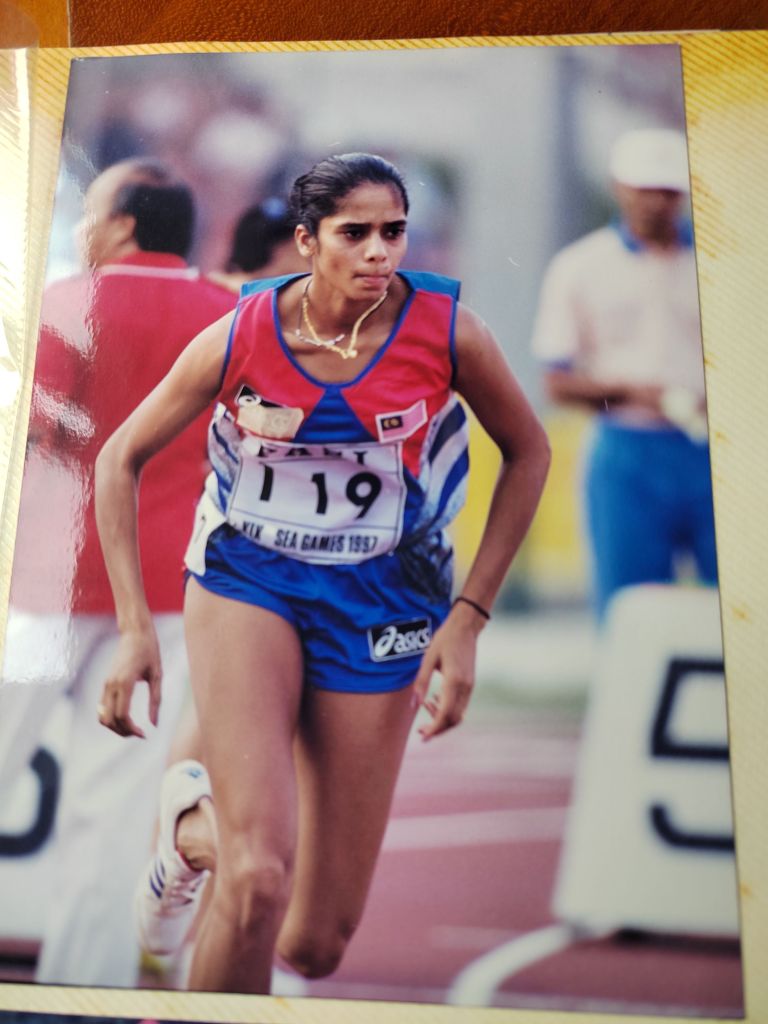
Solo running in the 1987 Sea Games

Solo does it solo for Arul

There is an age-old saying ‘Behind Every Great Man Is A Great Woman’ and it cannot better describe national hockey coach Anthoni Arul Selvaraj’s wife, former national athlete, Soloseeni Krishnan. 

This expression originated sometime in the first half of the 1900s. People use it to try to give recognition to the wives or mothers of successful men. This is because the women often helped the men in their lives a lot, but their work went unrecognised.

Arul, named the ‘Coach of the Year’ on Sunday, the 49-year-old former national player, who had set up his home in Dublin, Ireland 15 years ago, indeed owes a great deal to Solo, as his wife is affectionately known, as he uprooted himself from Dublin as a hockey coach to a couple of countries before landing back in Malaysia.  

Solo, when I met her and her eldest daughter Tharine in Dublin last week, where I was a technical official for the World Baseball Softball Confederation (WBSC) for their Women’s Softball World Cup Group Stage Group A in Ireland, this is what she had to say about Arul being away from home: “Since 2012 August, up to now, he has been in and out of the country.

“He came back home for good in 2019 September but unfortunately early 2020 the Covid-19 lockdown happened, and he lost his income. Fortunately he got this offer as head coach for men’s team in Malaysia, and he grabbed the opportunity. Otherwise he would have jobless until 2021, when match only over here when hockey resumed and other business as well up, running as usual.”

Solo said it was a tough decision for her to allow Arul to take up the offer in Malaysia, as she had to manage the three girls – Tharine, Erin and Deepa – all by herself and bring them up to the best of her ability and Arul’s strict demands how the girls should be brought up.

“Arul is a humble and simple man, but a disciplinarian with great values towards life. He wanted to bring the girls up that way,” said the former athlete whose pet event was 800m.

Solo loves the quote: Life is a balance between holding on and letting go  – Rumi-, and has given her best to balance well and holding on.

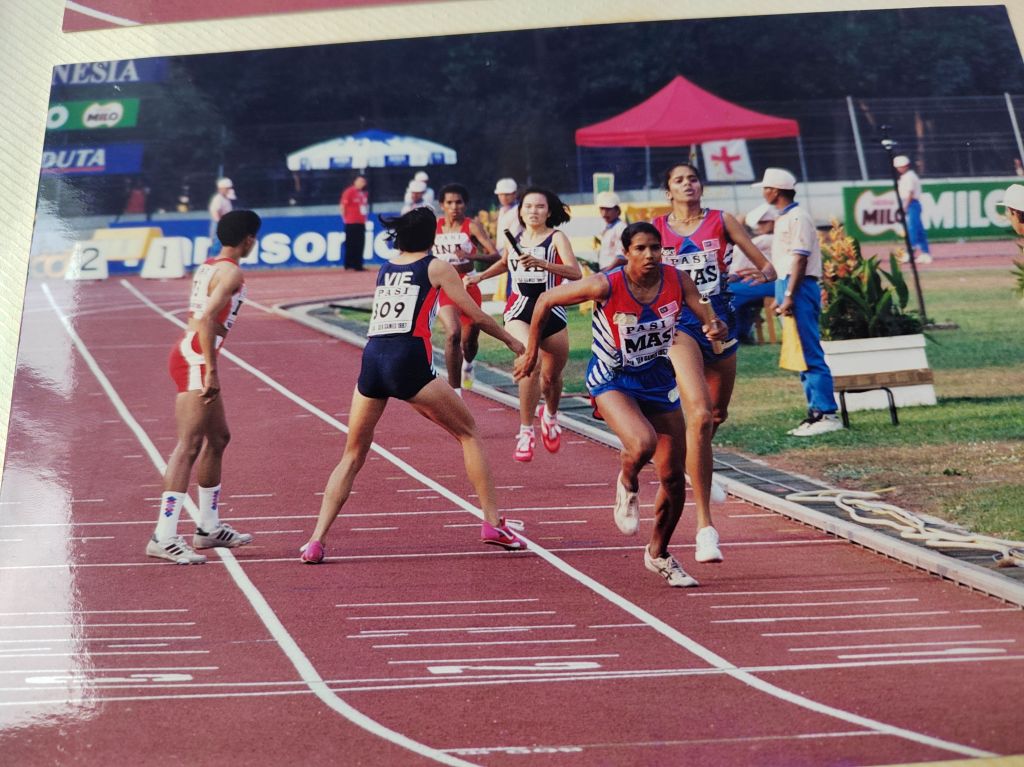
“I think I have managed well and been supportive of Arul, and glad that I played my role, although it was difficult at the start,” said Solo who has competed in the 1988 Commonwealth Games in KL, the Chiangmai (1995) and Jakarta (1997) Sea Games  in 800m and 4 X 400 quartet.

But it was hockey which was her first love and represented Negri Sembilan, her home town, where she led a simple life as an estate girl at the Kirby Estate, where her parents worked (father as a carpenter and mother as a rubber tapper).

The ninth of ten children, Solo used to help her mother during her rubber tapping rounds.

“Being brought up in a poor family, where values of life was utmost important from my parents, helped me a great deal in bringing up my children.

“Arul has thought the children to always be humble, respect everyone and never value life with material things or money.

“Here daily we past churches, temples and even mosques and he has thought the children, always to take bow when we pass, as a mark of respect.”

Having met Tharine twice – once when he came back with Arul for a short vacation and in Dublin last week, indeed Arul and Solo have raised a respectful and warm person, who was a delight to be with.

Arul’s two other children Erin and Deepa, are currently on a short break with him here and Solo will be here next month for prayers for her late mother who passed away recently but was unable to attend the funeral.

The next question to her was that with a sporting genes parents, if any of the daughters were into sports.

“All are into sports in school, but except for Erin, the others just took it was a recreational sports,” said Solo who also represented Negri Sembilan in hockey at Sukma and inter-state.

“Erin is into athletics and I train her personally, but athletics is not big here and hardly gets any big competition. If she keeps up her interest, then maybe we have to look into other opportunities to pursue her athletics career.

Solo’s involvement with athletics was because she took it as a challenge to represent the nation after she was dropped as a 17-year-old for the national women’s hockey team for the Singapore 1993 Sea Games.

“I was upset, although I was only 17,  felt that I was good to make the squad and was unjustly dropped. It was then I quit hockey and moved on to athletics,” said Solo with a tinge of sadness but full of pride and joy that he took the challenge and managed to represent the nation in another sport – athletics.

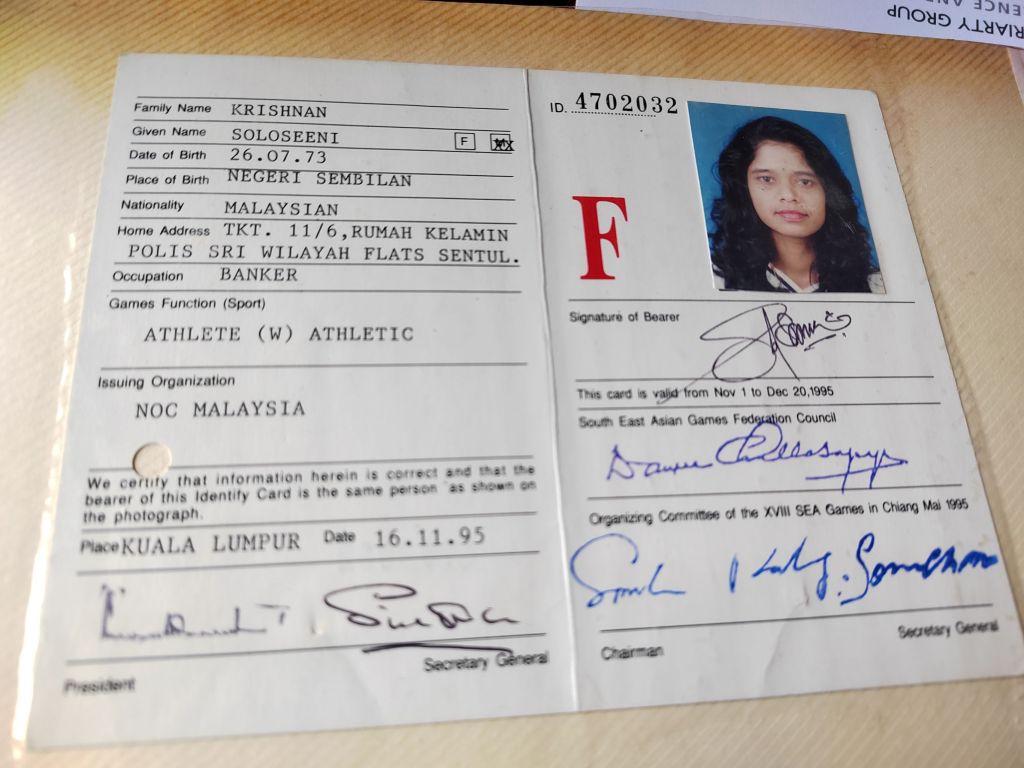
“I took the next 18 months seriously and qualified as an athlete for the 1995 Chiangmai Sea Games.

“I am a fighter and work hard to achieve what I set out to do. And I suppose it is these traits that help me manage the home here in Dublin, although Arul was not around.

“Hockey was my passion and wanted to represent the nation to follow the footsteps of my older late sister (Deviswarry) by five years to me, who represented the national women’s hockey team at the 1989 and 1991 Sea Games and Asian Games.”

Deviswarry, a mother of three, passed on at the age of 49 after short illness.

“Devi was in the limelight in hockey as a school girl when the Kirby School won the Negri Sembilan State championship.

“Naturally, I wanted to follow her footsteps and when it did not happen, I was determined to became a national athlete in a different sports.”

Solo said she was asked to switch to athletics as early as her schooldays when she trained with her King George V School hockey team and the late Negri and later national athletics coach, JV Jayan spotted her, when he had athletic training at the school field after her hockey training.

“Coach Jayan asked me many times to switch to athletics as he said he saw the potential in me. But was so focused on hockey, that I declined the offer.

“But after being dropped for the national hockey team in 1993, I decided it was athletics for me and took it up seriously to full fill me dream to become a national athlete.”

Solo said besides Jayan he had to thank many former athletes and coaches who made her athletics career take off.

“Besides recommending me for a job with Maybank, which was big into athletics at that time, many coaches groomed me too.

“Among them include Sitheravellu Sathasivam, Stanley Sreedheran, Murugiah, Nur Herman Majid,Harun Rashid, late Mohd Hanifah Nasir, R. Jeganathan to name a few.

“At the national level, the late Pavel Litovvhenko (passed away 2010) guided me a great deal, while wife,  Liliya (Russian Olympian middle-distance runner who was the silver medalist in the 800m at the 1992 Olympics) who was in Malaysia with her husband, personally helped me to become a better athlete.

“I am still in touch with her who is in Moscow coaching the tennis team.”

Solo’s personal best at the 800m was set in 1997 at the Chinese Taipei Open where she clocked 2.07.88 which was just off the current national record (2.07.44) set by Josephine Mary Singarayar at the 1986 at the Seoul Asian Games. 

Other impressive records Solo achieved Negri Sembilan Sportswoman of the Year in 1997, Sportswomen national inter-bank in 1996, 1997 and 1998 and hold several records at the state meet championships till now.

Fellow athletes she used to train with include the likes of  Nur Herman, Kenny Martin, Yusri Sijam, Azliy Izahar, Ratimalar, Mogan Rajoo and Vasu Subramaniam.

“So it has not been a bed of roses for me all along and have been brought up to fight hard for whatever I wanted to achieve even against the odds, and I am glad that I have come this far.

“Not bad for an estate girl now living in Dublin, married to a famous hockey coach and have three beautiful children uh,” asked Solo with a burst of laughter with her daughter giving her the looks.

Indeed, Solo has done well and can be proud of herself and when she celebrates her 50th birthday on Wednesday (July 26), she certainly can look back with her achievement with pride and joy.

Happy birthday Solo and Arul must surely be very proud and lucky to have you as his woman in his life. 

Christmas in Dublin
Solo passing the baton to third runner G.Shanti
Solo’s accreditation card for the Chingmai Sea Games in 1995

Wednesday, March 8, 2023

TALENT TAP WAITING TO BE TAPPED

TALENT SCOUTING THE WAY FORWARD

By Tony Mariadass

PHILIPPINES, former Gintong Alay executive director, Michael Keon, hit nail on is the ill of sports in many developing countries including Malaysia - lack of talent scouting.

Keon, who was largely responsible for the rise of Philippines sports through his Gintong Alay project in the the 80s, gave his unsolicited advice to Philippines Sports Commission (PSC) chairman, Richard Bachmann,  after the former paid tribute to the greatest athlete he has ever produced from the grassroots program - the late Lydia deVega-Mercado.

It was reported in The Philippine Star today, Keon the incumbent mayor of Laoag City, had emphasised PSC that concentration should paid to talent scouting, in during his tribute speech for De Vega-Mercado, who elevated by the Philippines Sportswriters Association to Hall of Fame status during its awarding rites at a leading hotel on Monday night.

De Vega-Mercado, the fasted Asian Women for eight years - 1982-1990 (holder of 100m with 11.28s in Sea Games - 1987, 1991,1993 - and 200mm- 23.25second - from 1981, 1983,1987 and 1993 -  and Asian Games two gold medalist (1983  last year after battling with cancer.

“There’s so much talent in Philippines sports and that is why when chairman of PSC came to visit me in Laoag, we talked to one another about what is most important when it comes to Philippines sports now and I made suggestion to him that PSC along with National Sports Associations (NSAs) should concentrate in talent scouting,” Keon had said in his speech.

“There is so of much talent in this country that falls through the cracks of the system and it’s really sad, so this is why I suggested to him (Bachmann) and I believe he is listening to me and he would initiate talent scouting,” he added.

Proof of the pudding was Keon’s Gintong Alay product, De Vega-Mercado, who at  a tender age 16 years in 1980, or the year after the creation of the fabled Gintong Alay, bettered the Philippine, South Asian and Asian Games records in one memorable run in the UAAP versus Gintong Alay  meet, reported The Philippine Star.

De Vega-Mercado went on to win two goal medals in the Asian Games, four in the Asian Athletics championships and nine in the Sea Games and set numerous records that cemented her status as one of best, if not the best, athletes Philippines had produced.

And Keon believed De Vega-Mercado  could have won more.

“If Lydia had continued to train from 16 to 24 years old, she could have easily broken 50 seconds which could have won her an Olympic medal and have been an Olympic champion for me.

“In fact, India’s PT Usha, Lydia’s greatest rival, won the Olympic bronze medal inn the 400m hurdles,” Keon had added.

Indeed, there is so much truth in Keon’s concern of lack of talent scouting, which is not only a concern for the Philippines but in Malaysia too.

Malaysia has headed towards getting possible short term success with their naturalised programme especially in football where at least 20 players have been granted citizenship since 2015, whereas in the Malaysian Football League (MFL) there is easily 110 foreign players on parade - where each team is allowed to register 9 players - with only five allowed to be fielded at any one time (three plus one Asian n One Asean player.

Hockey and basketball too, has foreign players plying their trade in league and many other sports are following suit and matter of time others join the bandwagon of  football’s way.

Malaysia is certainly not lacking in talent and there is abundance in the country, especially in East Malaysia, East Coast and Northern States.

Problem is that these talented players are not found, neglected or find it hard to get into the main stream of action.

Above all, Malaysia sports lacks talent scouting culture.

Yes, we have had random talent scouting programme done by the National Sports Council and National Sports Institute, spending millions for findings and hiring individuals to conduct the programme, but in the end did not produce the wanted results.

NSAs who should be the ones doing the talent scouting, have remained dormant.

Ex Internationals Associations for many sports have been time and again been reminded to play a key role in talent scouting, but they themselves have not been fully committed to the idea or blaming NSAs for not giving them the opportunity.

A more concerted effort is indeed needed from all quarters, if they are still passionate about raising the standard of Malaysian sports and giving Malaysian sportsmen and women the opportunity to realise their true potential.

There is no need to look for foreign talent because Malaysia is a multi-racial country and gifted that we have different strength from the various races - Malay, Chinese, Indian, Sikhs, Eurasian and not to mention the various ethnic groups we have in Malaysia - and combined together we will have a international strength team, without looking for foreign athletes.

Let’s stop trying to get short-term success and instead work on a long-term solution with long term programme over a minimum of one Olympic cycle but two definitely better, and it must be a continuous programme.

But first, let us scout the talent which is waiting to be tapped to give Malaysian sports a better future and reason to cheer for.