Friday, December 4, 2015

Make the right decisions

Commentary

Level Field


The future of three key sports — football, hockey and athletics — lies in decisions that are to be taken very soon.

As these decisions will determine whether our young sportsmen and women rise to stamp their mark or fade away after early promise, it is important that they are made wisely.

Popular decisions may not necessarily be the right ones and personal interests should be the last thing on the minds of the decision-makers.

To start with, the Football Association of Malaysia (FAM) have entrusted the Task Force headed by Datuk Mokhtar Ahmad to pick a new coach for the national Under-23 team from the three candidates interviewed by representatives from the FAM technical committee and the National Sports Council on Tuesday.

The views of the panellists will be conveyed to the Task Force who will then deliberate and make the final decision.

The three interviewees are current senior interim coach Datuk Ong Kim Swee, former Philippines coach Michael Weiss and former Estonia youth coach Frank Bernhardt.

The two Germans were shortlisted from 70 applicants but looking at their credentials, one wonders if they are the best coaches to chart Malaysia’s future.

Sure, whether the coaches wanted to come with their own back-up team and their terms and conditions are factors that would have been considered besides their track record, calibre and experience.

But to hire someone who had coached the Philippines (2011-14) and whose only notable achievement was elevating them to their highest Fifa ranking (127) then — they are at 123 now under Thomas Dooley — seems so wrong. Weiss also had many Filipino players of mixed parentage brought down from abroad to add strength his team.
The 50-year-old coach, who was a goalkeeper in his playing days, served internship with clubs like Real Madrid, Arsenal, Kaisrslautern and River Plate, to name but a few, was a technical director with Rwanda, assistant manager of China’s Under-20 team and in June 2014, took charge of Romanian former champions Otelul Galati but was sacked only three months later after a single win in seven games.
FAM had indicated that they were looking for someone who had knowledge of the football scene in Asia but if that is the only reason they are considering Weiss, then Ong would definitely be a better choice.
Ong guided Malaysia to the gold medal at the 2011 Indonesia SEA Games and his local and Asian knowledge is surely better than that of the foreigners.
FAM already made a mistake by dropping Datuk K. Rajagobal, who did a great job of raising the profile of Malaysian football, but he was let go in the name of change and external factors that had nothing to do with football.
To repeat the mistake would be foolish. Although Ong has baggage, he is still a better bet than the Germans.
As for the 46-year-old Bernhardt, his notable achievement is taking the Estonian (five years) Under-19 team to the European Championship elite round in 2009 and 2011. His last job was with Sumgayit FK in Azerbaijan.
Let us not change our coaches for the sake of changing. And if we need foreign coaches, they must be reputable with a proven record.
It would be better to get a football supremo to be in charge overall of the senior and junior teams and let local coaches handle the teams. This way, the local coaches can be the understudy and take over when the foreign supremo’s tenure has ended.
Just like football, hockey is in trouble, having failed to qualify for the 2016 Junior World Cup. Though the team had led 3-1 against Korea earlier in the match, they allowed the Koreans to pull level and lost the game in the ensuing penalty shootout.
Malaysia has also failed in its bid to host the 2018 World Cup, the national team lost in the 2015 semi-final of the World League, did not qualify for the Olympics and saw its world ranking slide from 12 to 13.
So, it is back to the drawing board for hockey. The 2016 Junior World Cup squad was undoubtedly one of the best prepared with full sports science support but sadly, they lacked the mental strength and intelligence to withstand pressure and make vital decisions.

But to disband this squad would be a crying shame. All indications are that the Malaysian Hockey Confederation (MHC) will look at ways to maintain it as a back-up squad.

That's wise because otherwise a lot of good talent would go to waste without proper guidance and programmes. Malaysia hosting the 2017 SEA Games would be a springboard for them.

As for athletics, the sport is in the limelight for the right reasons, thanks to Badrul Hisyam Manap’s feat at the Asean Schools Games in Brunei where he set a new national record, breaking Watson Nyambek’s 17-year-old 100m record by clocking 10.29 seconds, and the 4x100m relay team (Badrul, Mohd Haiqal Hanafi, Asnawi Hashim and Khairul Hafiz Jantan) winning the gold medal.

As expected, everyone is excited and many will jump on the bandwagon to share some of the glory and try and chart the future of these athletes.

But how many of them even knew where the Tunku Ismail Sports School (TISS) was? Did they know it had 500 young talented boys and girls for 14 sports?

Everyone wants a bit of the spotlight. They are jostling each other to take charge of Badrul and have even suggested that he be brought to the city.

A grave mistake was made when Watson was dragged from his quiet life in Miri to Kuala Lumpur, where his full potential was never fully realised.

Let us not repeat that mistake with Badrul. He should remain in the fully equipped TISS in Bandar Penawar.

Sadly, for a sports school, TISS has minimum sports science elements at present, with one administrator for the unit, a nutritionist, a psychologist and a strength trainer. The unit does not have the best of training equipment, yet it has produced results.

So, let’s enhance what has been achieved with minimum facilities and fully support TISS principal Suhaimi Sun Abdullah in producing more sportsmen and women. Let us not cripple the school by taking away its talent.

Let’s make the right decisions for the future of Malaysian sports.

TONY MARIADASS is a sports
journalist with more than
three decades of experience
and is passionate about
local sports.
He can be reached at
tmariadass@gmail.com
Twitter: @tmariadass​​


Thank you, Cikgu Nora

By Tony Mariadass


Rising sprinter Badrul Hisyam Manap has to thank his teacher Noraziah Kassim to thank for spotting his talent as a Standard 1 stundet of SK Batu Gagah in Merlimau.
Badrul, now 18, gained nationwide fame after breaking Watson Nyambek;s 17-year-old 100m record (10.3s) at the Asean Schools Games in Bandar Seri Begawan, Brunei last week. Badrul clocked 10.29s.
“If not for Cigku Nora, I will not have achieved what I have so far. I am grateful to her not only in spotting me, but also introducing to my coach Cikgu Poad (Mohd Poad Md Kassim), said Badrul at his home in Kampong Batu Gagah where he had thanksgiving lunch for his childhood friends and teachers
Noraziah, a Bahasa Malaysia teacher had no formal coaching background but always was interested in sports
“Even in Standard 1, Badrul  had the ability to run faster than the rest of the children in school,” said the 41-year who lives just behind Badrul’s house.
“I then asked to do Phyical Education (PE) and kept an eye on Badrul. It was when he was in Standard Three that he started running in the school meet and was winning races.”
Noraziah then got involved in coaching more actively and was part of the Malacca Schools athletics coaching team. It was here she met Poad.
“I told Poad about Badrul and brought him to train in the city  regularly.”
Poad was then teaching at the SK Sungai Udang and travelled to Malacca town to coach the Malacca schools team.
Noraziah and Poad also had to convince Badrul’s father (Abdul Manap) and mother (Rozinah Baba) to allow their son to take up athletics.
“Badrul’s parents were not keen to allow Badrul to take up athletics, as they wanted their son to concentrate in his studies. But we managed to convince them Badrul will go far in athletics,” said Noraziah who was later transferred to SK Seri Bandar.
Badrul joined Malacca’s sports school, SMK Seri Mahkota, for his secondary education and Poad was also transferred there in 2003 to coach.
“Badrul came under Poad fulltime. He moved to Tunku Mahkota Ismail Sports School in Bandar Penawar and  with Poad when he was Form Four.
“It gives me great pleasure and honour to see what Badrul has achieved so far. But it is still early stages and he has still a long way to go to realise his true potential,” said Noraziah who holds a Level Two coaching certificate now and coaches throw events athletes.
Noraziah who also unearthed another talent in national back up javelin thrower Mohd Safizie Hasnol, believes discoverin of Badrul was not an accident.
“While I spotted him first, I introduced him to the schools programme in place. In fact SK Batu Gagah was a project school for athletes in Merlimau.
 “With with good programmes and dedicated teachers, we can unearth many more talent,” said Noraziah who got married last month.
“I will continue to look out for more talent and do my bit to develop them. I want to bring the best out of them.”


Saturday, November 28, 2015

Basketball's doyen Yeo


By Tony Mariadass

Pictures by Azneal Ishak (Malay Mail)

Hailing from tiny state Perlis, Datuk Yeoh Choo Hock, a former physical education teacher rose to become a legend in the development of basketball not only in Malaysia but Asia.
People like Yeoh are a rare breed who are prepared to sacrifice their health for the game.
Starting off as a state basketball coach in 1970, Yeoh has been involved in the game for 45 years now.
In 2012, he suffered a stroke mainly because of the stress of his job and extensive travelling he had to do in the name of the game.
When he wanted to step down as the secretary-general of the FIBA Asia where he had held the post from 1998 after suffering the stroke on Chinese New Year day when he was back in his hometown in Kangar, the game still sought his expertise.
FIBA Asia president Sheikh Saud Ali- Al-Thani did not want to let a man with such great knowledge and contribution he has made to the game, to just step down.
He called for an emergency meeting of FIBA Asia and changed the constitution to pave the way to appoint Yeoh as the Emeritus secretary-general.
That is the kind of admiration, adulation and adoration Yeeo has garnered for his services.
Accolades for Yeoh are non-stop and everyone in basketball only has nice things to say about him.
Some of the accolades that has come his way include: Some men are born great. Some men have greatness thrust upon them. And some men are the very definition of greatness. Yeoh belonged to this rare third group of men,” attributed S. Mageshwaran from India who wrote extensively on basketball in Asia.
“Yeoh was not born a legend. But for sure he grew into a legend with an approach that was driven by simplicity, but with unflinching focus and dedication with a touch of spirituality underlining his entire life,” said Sheikh Saud at the appreciation gala dinner for Yeoh in 2012.

Olympic Council of Malaysia (OCM) long time secretary-general and now assistant secretary said: “Yeoh is a very hard working person… full of ideas, full of energy. He has devoted his whole life for basketball. The biggest contribution he made to basketball was that he really worked hard at popularising basketball among the various ethnic communities in Malaysias when he ran the non-Chinese basketball tournaments.
“He initiated the Basketball for Peace movement, which is quite extraordinary, because I don’t think any sport organisation has done that.”
Indeed that was Yeoh and he readily admits that basketball is his way of life.
“My life has been only basketball. I can’t imagine leading a life without basketball,” said Yeoh who turns 71 on Dec 20.
“Basketball has been my religion. Basketball has been my God. I made some wonderful friends through basketball.”
Yeoh is still the modest man he is known for despite his vast contribution and achievements from the game.
Yeoh’s journey with basketball began in 1970 when he became the head coach of Perlis Basketball Association, a position he held till 1975. He also became the Advisor of Perlis Basketball Association in the year 1980 and remains so till date.
He was the national coach from 1975 to 1989 and moved to administration of the game when he became the deputy secretary-general of Malaysia Basketball Amateur Association of Malaysia (MABA) in 1984 and then became the secretary-general from year 1990 to 2008. In 2008, Yeoh was elected as a vice president of MABA for a four-year term.
Yeoh has been one of the greatest contributors of basketball in Malaysia - the 12-storeyed Malaysian Amateur Basketball Association (MABA) building – is a standing testimony.
MABA House which took shape in May 1971 saw Yeoh carry on the creation and dream of a resourceful man and who had become president of MABA six years earlier, the late Tan Sri Khaw Khai Boh  who was then the Minister of Housing and Development.
Together with the likes of Datuk Lee San Choon and Datuk Chan Ah Chye, Yeoh took MABA further through and expansion phase with the building of the Basketball Stadium and carpark when he was appointed the build committee chairman.

Yeoh raised the money for the building through a lottery draw and also hosting China to a first basketball friendly in Malaysia after diplomatic ties was established in 1974, where a total RM10 million was raised for the project.
The perseverance, persistence, panache and a penchant for hard work, has certainly made Yeoh not only a mark in Malaysia but synonym for basketball in Asia and the world of basketball.
He has held several important positions in almost every position and top sport organisations in Malaysia and abroad.
At the International Olympic Committee (IOC) Yeoh, was a member of the Coaching Committee from 1987-2008.
At the Asian Basketball Confederation as it was known then, Yeoh began his career as a technical assistant to the ABC from year 1983 to 1990, and then became the deputy-secretary general from 1994 to 1998.
Yeoh is also the founder-secretary general of the Southeast Asia Basketball Association (SEABA), being one of its founding fathers in 1994.
At the Commonwealth basketball level he was a key contributor in the basketball development amongst Commonwealth nations holding the position of treasurer in Commonwealth Basketball Association from 1983 to 1997 and vice president from year 1998 to 2006.
At the International Federation of Basketball Asia (FIBA Asia), he held the position of secretary-general from 1998 to 2012.
At FIBA, the world body, Yeoh was a member of the Technical Commission from the year 1990 to 1994, member of the FIBA Central Board from 1998 to 2006, and honorary vice president from 2002 to 2006.
To sum it up, Yeoh has held every position the game has to offer in Malaysia, Asia and world.
A national Level 3 Certificate holder since 1974, Yeoh also guided the Malaysian National team to several achievements, has been team manager at  the 1987 Sea Games in Jakarta, FIBA Commissioner at three Olympics (1992 in Barcelona, 2000 in Sydney and 2004 in Athens) and FIBA World championships for men, youth women and women .
Among the top awards and recognitions awarded to Yeoh include:
1997: Best CEO Award by USA Basketball Association
2001: John Wooden Life Service Award by USA Basketball Association
2000: Millennium Recognition Award by Malaysia Association of Physical Education in Sports Science.
In recent years, Yeoh also has held the position of CEO for Malaysian Basketball League MBL from year 2005 to 2006.
He has also organised a basketball invitation tournament in Myanmar in year 2003 to promote world peace. With six countries participating, the event was first ever basketball event to be organised in Myanmar in more than 33 years.

No one can match the legacy Yeoh has left for basketball and it is only fitting that Olympic Council of Malaysia induct him into their Hall of Fame when they announce the latest inductees at next month.

Friday, November 27, 2015

Damned if you do, damned if you don't


Commentary

Level Field

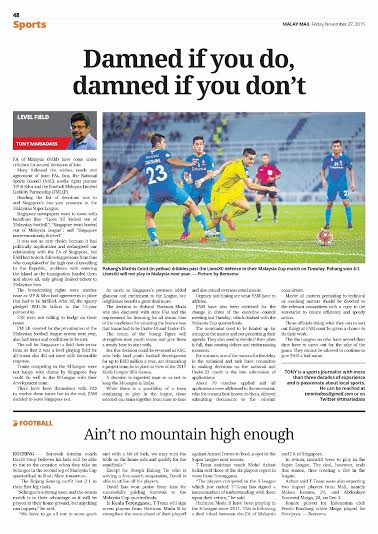
The Football Association of Malaysia (FAM) have come under severe criticism for several decisions of late and while they have themselves to blame for some of them, many were consensual and in line with moving forward.
Many of the decisions were driven by the wishes, needs and agreement of the state FAs, fans, the National Sports Council (NSC), media rights partner MP & Silva and the Football Malaysia Limited Liability Partnership (FMLLP).
Heading the list of decisions made at the FAM executive committee meeting on Tuesday night, which received mixed reaction, was to end Singapore’s four-year stint in the Malaysian Super League.
In 1994, Singapore had parted ways with Malaysian football after winning the Malaysian League and Cup double.
After the recent decision, the Singapore newspapers went to town with headlines like: “Lions XII kicked out of Malaysian football”; “Singapore team booted out of Malaysia League”; and “Singapore unceremoniously ditched” , which were not very complimentary to FAM.
It was not an easy decision because it had politically implications and endangered our longstanding relationship with the FA of Singapore, but FAM had to do it, following pressure from fans who complained of the high cost of travelling to watch matches in the Republic, problems with entering the island as the immigration hassled them and above all, only giving limited tickets to Malaysian fans.
The broadcasting rights were another issue as MP & Silva had agreements in place that had to be fulfilled. After all, the agency had pledged RM1.26 billion to the 15-year partnership.
FAS were not willing to budge on these issues, making it difficult for FAM.
FMLLP, created for the privatisation of the Malaysian football league system next year, also had terms and conditions to be met.
The call for Singapore to field their senior team so that it was a level playing field for all teams also did not meet with favourable response.
Teams competing in the M-League were not happy with claims by Singapore that they could do well in the M-League even with their development team.
The state FAs wanted the best team from Singapore so that such talk could be dispelled.
There have been discussions with FAS to resolve these issues but in the end, FAM had to decide to leave Singapore out.
As much as Singapore’s presence adds glamour and excitement to the League, our neighbour benefit a great deal more than Malaysia from their participation.
The decision to disband the Young Tigers team, which has drawn flak as well, was also discussed with the state FAs and the requirement for licensing for all teams; one of the conditions for attaining the licence was that the teams had to be Under-18 and Under-15.
The return of the Young Tigers will strengthen the state youth teams and give them a steady base to start with.
But this decision could be reserved as the NSC, who are assisting in funding youth football development and have increased the funds to RM3 million a year, are demanding that in view of the 2017 Sea Games hosted by Malaysia, a project team has to be in place.
A decision is expected to be made soon and it is of utmost importance so as not to keep the M-League in limbo next year.
While there is a possibility of a team continuing to play in the League, the project team can be kept for training from time to time and also to attend overseas attachments.
Urgency and timing are what FAM have to address at once.
FAM have also been criticised for the change in the dates of the exco meeting last Tuesday, which not only clashed with the Malaysia Cup quarterfinals but also was informed late. The secretariat need to be hauled up for sitting on the matter and not prioritising their agenda.
They also need to decide if their plate is full, thus causing delays and embarrassing moments.
For instance, one of the reasons for the delay in the technical and task force committee in making decisions on the national and Under-23 coach is the late submission of applications.
About 70 coaches had applied for the job and all the applications were addressed to the secretariat. The secretariat, for reasons best known to them, delayed submitting the documents to the relevant committees to be vetted.
Maybe, all matters pertaining to technical or coaching matters should be directed to the relevant committees with a copy addressed to the secretariat for their knowledge to ensure efficiency and speedy action.
Indeed, the secretariat need to buck up to avoid further embarrassing FAM.
All said, FAM, as much as they have been hit by criticism, are trying their best to move forward in the best interests of the sport.
Those officials who are doing what they can to sort out things at FAM must be given a chance to do their work. Meanwhile, the hangers-on who have served their time have to move out for the sake of the game. They cannot be allowed to continue to give FAM a bad name.

TONY MARIADASS is a sports
journalist with more than
three decades of experience
and is passionate about
local sports.
He can be reached at
tmariadass@gmail.com
Twitter: @tmariadass​​


Mystical Muscat


By Tony Mariadass

 Explore the secrets of Oman


Muscat, Oman never ceases to captivate visitors with its historical architecture water sports and treasures. An unlikely place one wants to visit, but a visit will reveal how much Oman has to offer, which is unique and experiences which will leave an everlasting memory. It has a variety of experiences awaiting for in inquisitive traveler.


  Not many people would consider Oman a holiday destination but it will surprise with what it has to offer.
The Sultanate of Oman may not boast may 'firsts' and 'biggest' like its neighbours however its rich history, traditional charms and pristine coastlines is gaining popularity among travellers.
Some may not even know where thus Gulf nation is.
Nestled on the eastern end of the Arabian Peninsula. It borders the United Arb Emirates in the northwest, Saudi Arabia in the west and Yemen in the southwest. It also has two enclaves – the Musandam Peninsula and Madha – which is separated by UAE.
Oman overlooks the Arabian Sea, the Sea of Oman and the Arabian Gulf. It also controls the Strait of Hormuz, which is one of the most important facilities in the region, linking the Sea of Oman with the Arabian Gulf. The Strait of Hormuz is a gateway to all ships coming from the Indian Ocean and Arabian Sea.
Oman is a seaside nation with a coastline spanning 3,165 kilometres!
Little surprise that a wide variety of activities are sea related.
Oman had hosted 2nd Asian Beach Games in 2010 held in Muscat and Almusannah.
A total of  12 sports – bodybuilding, beach handball, beach kabaddi, beach football, beach sepak takraw, beach volleylwoodball, jet ski, marathon swimming, sailing, tent pegging and triathlon – were held.
Among the experiences a traveler can experience include a wide variety of pristine beaches and islands, world class diving, snorkeling and other water sports.
Weekend picnics and barbecues are popular on the beaches and people driving their cars right up to the shore to park and chat is a pretty common sight.
While turtle and whale watching is an attraction, it is the dolphin watching is a main attraction, especially in Muscat and Musandam.
There are various dolphin watching tours, including travelling in boats which has see through glasses at the bottom of the boat.
I indeed had a whale of time watching these beautiful dolphin shoals.
My dolphin adventure began at the Oman Marina, which is home to some of the yachts of the rich and famous. Bobbing next to those huge vessels was this little speedboat that we were to board. It whisked us off, speeding into the open sea.
 Normally it takes between 20 to 30 minutes to spot the dolphins, but there are times when visitors have returned from the trip not sighting a single dolphin. It is the first thing operators warn the visitors stating that there is no guarantee to see the dolphins.
I was lucky that I saw hundreds of dolphin but not before anxious moments that I may return disappointed. It took about 40 minutes into the deep sea before we spotted several other boats who had already spotted the dolphins.
It was truly amazing to see the gentle creatures swimming freely and performing flips, for our entertainment, we presumed. Everywhere we looked we saw dolphins. And they didn’t seem to mind the boat or us, swimming around like we weren’t even there.
We feasted our eyes on the hyperactive dolphins for half an hour or so before the boatman took us back to the marina.
The round trip took about two hours and cost 15 Omani Rial (RM188.00).
If anything, dolphin watching alone is worth a trip to Oman!
Mountains constitute a large percentage of the environment of Oman which would mean that even a short drive to have dinner will involve driving through the scenic mountains. But the highways and roads in Oman are top-class and on a par with Germany’s Auto-Bahn. The only difference is that there is a speed limit and the roads twist and turn around the mountains.
Muscat is the capital of Oman and perhaps the country’s most cosmopolitan city.
Muscat is a wonderful blend of tradition and modernity, which is what makes it so unique. Today, it protected by a stone moat that replaced the walls that had shielded this important city. Walking through some of the older parts of Muscat, you see how the old historical buildings have been beautifully preserved and enhanced with modern additions.
Cultural sites including forts, ancient tombs and prehistoric sites are all there to explore.
One thing that stands out about the city is that you hardly see any building above five storeys.
   The Grand Mosque at Sultan Qaboos St is glorious piece of modern Islamic architecture was a gift to the nation from Sultan Qaboos to mark the 30th year of his reign. Quietly imposing from the outside, the main prayer hall is breathtakingly rich. The Persian carpet alone measures 70m by 60m wide, making it the second-largest hand-loomed Iranian carpet in the world; it took 600 women four years to weave. The mosque can accommodate 20,000 worshipers, including 750 women in a private musalla (prayer hall).
The Royal Opera House Muscat offers concerts and performances at a very affordable prices as compared elsewhere in the world.
The arrival of the Royal Opera House Muscat in 2011 was a high point in the              cultural life of the capital. Built by the same architects as the Grand Mosque, the         understated marble exterior belies the magnificent interior of inlaid wood and 
 Arabesque designs.
 A not to miss while in Muscat is the Mutrah Souq (market and bazzars).


Many people come to Mutrah Corniche just to visit the souq, which retains the chaotic interest of a traditional Arab market albeit housed under modern timber roofing. There are some good antique shops selling a mixture of Indian and Omani artefacts among the usual textile, hardware and gold shops. Bargaining is expected but the rewards are not great, as any discount will be small.
 
Other experiences in Oman include exploring and experiencing include wildlife tours in the Sultanate’s nature reserves and biodiversity spots.
Desert safaris and adventures is another for adventurous visitors not to be missed.
Trekking, rock climbing and caving adventures is also available besides horse and camel events to watch.
Indeed, one is not short of experiencing something to one’s taste in Oman.
It is an understatement to say that there are many secrets to be explored in Oman.

How to get to Oman:

Oman Air has a direct flight from Kuala Lumpur to Muscat and it takes about seven hours.

One can also fly to Muscat via Dubai or Abu Dhabi or even take a car ride which takes about four hours.

Friday, November 20, 2015

Get it fixed


Commentary


Is match-fixing, which has become a global menace in football, being swept under the carpet in Malaysia?
Not a week goes by without insinuations, whether at home or abroad, of matches being fixed. Although no concrete proof of this mischief ever surfaces, betting trends and results indicate manipulation.
And the fact that Malaysians have been linked and even arrested in connection with match-fixing overseas leads to suspicions that they may be involved in local football as well.
Singapore has made football betting legal but it keeps a close eye on the activity and makes arrests from time to time, prosecuting the errant.
Malaysia, however, has taken a lax stand. Or least that is the impression we get because we hardly ever hear of offenders being hauled up.
Even Malaysia’s 10-0 drubbing at the hands of United Arab Emirates and 6-0 by Palestine in the World Cup qualifier did not see our football authorities investigate.
Instead, in a written parliamentary reply by the Youth and Sports Ministry (prepared by the National Sports Council) to a question from the opposition on Malaysia’s 10-0 loss, the reason given was: “The national football squad Harimau Malaya was too tired after playing a slew of both friendly and local matches before their game.
“Several weakness were identified. Among others, fitness level was low during the defeat due to tight schedules, including international friendlies.”
Interestingly, when the national team went for a friendly match in Muscat, Oman, in March and arrived two days prior to the fully sponsored match by the Oman FA, they were more interested in having a sumptuous dinner at a Malaysian restaurant on the first day and another dinner at the Malaysian ambassador’s resident, before going down 6-0 on match day, having undergone minimum training.
Before the return leg match against UAE on Tuesday, Sports Minister Khairy Jamaluddin said the demise of Malaysian football can be blamed, in part, on continuing problems with match-fixing, which was the final nail in the coffin.
He said before winding up the 2016 Supply Bill for his ministry: “Match-fixing has been shackling national football since several years ago. But continuous effort is being carried out by the FA of Malaysia, Malaysian Anti-Corruption Commission and the Royal Malaysian Police with the ministry to combat the scourge.”
What is puzzling is that the national team gets a drubbing in one game and loses the very next game with a decent score. A team cannot go bad overnight or bounce back with creditable results in another. Inconsistency arouses suspicions of what is going on with the team.
During the June Sea Games in Singapore, a bookie was arrested, charged and convicted for bribing a Timor Leste official to arrange for his team to lose to Malaysia.
Whether FA of Malaysia saw the need to pursue the matter on the Malaysian side is a mystery.
How much is being done in Malaysia to combat match-fixing?
Since the 1994 football bribery scandal, in which 126 players were questioned over corruption, 21 players and coaches were sacked and 58 players were suspended, many other cases have surfaced.
In Perlis in 2012, players admitted to having a contract with a bookmaker to lose matches, and in the same year, FAM suspended 18 youth players and banned a coach for life for match-fixing.
Kuala Lumpur FA were also in the middle of controversy of engaging a sponsor who was suspected of being involved in match-fixing and several players were implicated two years ago.
More recently, the Football Association of Penang (FAP) lodged an official complaint to the FAM integrity committee over the nature of T-Team’s 7-0 Premier League victory over basement club SPA Putrajaya in Kuala Terengganu.
FAM secretary-general Datuk Hamidin Mohd Amin defends the role of the national body in combating match-fixing by the fact that they have already set up the Integrity Committee since 2010 and had made it compulsory for every affiliate to set up such a committee in their respective states in 2013.
The committee is chaired by Tan Sri Aseh Che Mat and includes Bukit Aman CID director Datuk Seri Mohmad Salleh, Bukit Aman's Secret Societies, Gambling and Vice-Division principal assistant director Senior Asst Comm Datuk Roslee Chik, Malaysian Anti-Corruption Commission's Datuk Shamsun Baharin Mohd Jamil and Datuk Azam Baki.
The committee is responsible for screening, investigating foreign and local players and officials involved in the M-League to ensure that bribery or match-fixing is not involved.
Khairy also had said that several suspects and syndicates had been identified and were being monitored by MACC and PDRM.
But have they done enough and have action been taken?
It was indeed puzzling that FAM who earlier this month engaged Sportradar sports data technology and services provider - the agreement did not include their renowned betting pattern monitoring service
Despite calls from Crown Prince of Johor Tunku Ismail Ibrahim – urging the national body to utilise Sportradar's monitoring services, which raises red flags based on betting patterns for potential match-fixing, FAM chose to leave it out.
"We did not touch on monitoring of betting patterns in regards to this agreement. There were some discussions in the past ... it is something we need to look at further in the near future," said FAM deputy president Datuk Seri Abdul Mokhtar Ahmad had said when signing the deal earlier this month.
Even the Asean Football Federation (AFF) who engaged the services of Sportsradar’s Fraud Detection System (FDS), which was used to monitor the AFF Suzuki Cup recently, had urged FAM to engage them to fight match-fixing in the M-League.
With such lack of urgency from FA of Malaysia, it will be little wonder if match-fixing in Malaysia will continue to have a field day.
Even Nepal FA had got their act together to combat match fixing and had players charged recently for match-fixing in world cup qualifiers.
Before the start of the Malaysia Cup competition, I had mentioned to a few friends that club teams – Felda United and PKNS – will have a grand run in the tournament. Any takers?

TONY MARIADASS is a sports
journalist with more than
three decades of experience
and is passionate about
local sports.
He can be reached at
tmariadass@gmail.com
Twitter: @tmariadass​​