Showing posts with label Level Field. Show all posts

Wednesday, December 13, 2023

MOVING FORWARD TO STAND ON THEIR OWN

Moving forward to stand on their own

IT is heartwarming news that the Malaysian Hockey Confederation (MHC) and Malaysia Basketball Association (MABA) have announced plans to look into business ventures.

This is a new approach and the nation will be rooting for their success.

The two sport bodies naturally need funds to enhance the progress of their respective sports.

MHC SHOP full of stock for sale.

MHC president Datuk Seri Subahan Kamal, when announcing the registration of a business entity under the name of Speedy Tigers Sdn Bhd last week, said that to win medals, there must be a consistent flow of money into their kitty.

Consider the cost – they must pay the juniors, seniors, as well as women’s local and foreign coaches. There are other costs still.

Subahan said MHC gets less money from the government. Understandably so. There are a host of other sports that must be funded.

As for sponsorship, there are only so many sponsors that can help them.

For the ongoing 13th Junior World Cup (JWC) at Bukit Jalil, it roughly costs MHC RM3.5 million, with the biggest slice of RM1.6m going to the International Hockey Federation (FIH) as a hosting fee.

There are also expenditures for the current New Zealand Tour (Dec 8-18) to prepare the senior squad for the Olympic Qualifier in January in Oman.

The women’s squad also needs money to prepare for their Olympic Qualifier.

MHC managed to secure sponsors from staunch supporters of hockey, Tenaga Nasional, RM1 million for the JWC, and other sponsorships from SpeedMart 99 RM1.2m and Orang Kampung (OK) RM300,000 worth of cash and sponsorship in kind.

MHC’s idea of registering Speedy Tigers as a business entity is to generate money for the long term as they also have many more tournaments coming up after the JWC.

MHC’s have set up their shop called ‘MHC Shop,’ which sells national jerseys, running and turf shoes on the ground floor of the National Hockey Stadium.

MABA, on the other hand, are looking to become the first financially self-sustainable national sports association (NSA) in Malaysia after signing a land redevelopment deal with Exsim.

The joint venture with Exsim will see Wisma MABA and the adjacent MABA Stadium at Jalan Hang Jebat demolished to make way for the new MABA Suitez @ KL City Centre project.

MABA-Exsim have dubbed the project a hospitality building – essentially a serviced apartment – featuring two blocks of 60-storey towers with approximately 1,200 units, though this remains subject to approval from the relevant authorities.

The project has an estimated gross development value of RM800 million.

MABA president Datuk Seri Lee Tian Hock said that MABA will receive a cash consideration of RM170 million from the deal, which will be reinvested by purchasing units in the new buildings.

Work at the site is expected to begin by the end of next year, subject to approval, and is expected to be completed within five or six years.

Lee said that when ready, MABA will have a very good stream of recurring income (through transient rentals) estimated to generate roughly RM4 to RM6 million each year.

This income will be used to help run MABA’s annual programmes which can cost between RM3 million and RM4 million each year, as well as cover operating expenses of about RM1 million each year.

Lee also said that they cannot keep asking the government for funding and cannot rely on donations all the time.

They have to learn to be independent.

Maba will also receive a 3,000 square feet office in one of the new buildings, with a three-on-three basketball court next to it, to use as their headquarters.

Wisma MABA, a 12-storey building, was developed in 1971 while the MABA Stadium, which has a seating capacity of 1,800 people, was built in 1995.

While it is encouraging to see National Sports Associations (NSAs) moving towards being self-reliant for their funds, they must be warned that funds generated through their efforts are properly accounted for, managed well, and used for their sports-related programmes.

NSAs must be wary of changes in officials during elections who may have different ideas to utilise the available funds and deviate from the original goals.

Let us not forget the misappropriation of funds, as in 2008, when RM3.8 million of the Malaysian Paralympic Council (MPC)’s funds were used for an unapproved, high-risk investment by its president.

This was done through a company called Paralimpik Ventures which the president and his two sons are majority shareholders. The money was channeled to a company in the US, where it became “irrecoverable” and the MPC were unable to contact the US company afterward.

The amount was initially written off the MPC’s accounts to cover the loss, but some committee members decided to run their investigations and concluded that it was a bad debt, meaning that it will remain in their accounts until the money is returned.

We must also be reminded of the Rakan Sukan funding programme which was initiated by the then Sports Minister, Datuk Abdul Ghani Othman.

The Rakan Sukan programme was introduced in 1994 to attract the private sector to invest in sports.

A man shopping at the MHC Shop.

It was a programme to prepare athletes for the 1998 Kuala Lumpur Commonwealth Games.

While it was a good programme for funding, sadly only a few sports made good use of it and enjoyed good relations with their sponsor even until now.

Hockey and basketball are two associations that have good relations with their sponsors, Tenaga Nasional and Petronas.

Malaysian Tenpin Bowling Congress (MTBC), is another association that looks for funds through their own initiative through sponsors like Century Logistics Holdings Bhd and proceeds from concerts.

Former National Sports Council (NSC) director-general Datuk Ahmad Shapawi Ismail, early last year, had voiced out his views that the Rakan Sukan may be reintroduced following recent government budget cuts for sports.

It is reliably learnt, that the Road to Gold programme maybe pursuing on a similar programme like the Rakan Sukan.

But again, whether it will work depends greatly on the NSAs who have to be accountable and transparent in using the funds provided. If the plans do materialise.

Additionally, some associations have been moving forward to create a positive image for their sports by requesting government assistance to provide land areas for their own buildings or exchange for land parcels.

The new FAM building will have five stories and will be located next to the ASEAN Football Federation (AFF) headquarters in Putrajaya Football City.

FAM, which has been based at Wisma FAM in Kelana Jaya since 1980, is expected to transfer all operations and governance to the new headquarters. It should be fully completed by early 2025. It opened in 1991 and was bought from the City Hall at RM2 per square foot.

Now, they plan to relocate.

When the building was constructed, the then vice-president, Tunku Imran Tuanku Ja’afar, proposed the idea of having a permanent tenant – a hotel – that would ensure OCM a steady stream of income.

OCM also serves as an office space for many national sports associations. OCM now hopes to move with the times and relocate to a new state-of-the-art building by the end of 2025.

OCM’s reasoning for reallocation is that as an umbrella body,a new facility is required to serve Malaysian sports better.

Among the areas being considered are Bukit Jalil and Putrajaya because of their proximity to the National Sports Complex.

It is said that the financing for the new building will be done by disposing of the current Wisma OCM building and site. Options such as working out a land swap are being considered.

All is well and good in the name of progress and moving forward, as long as everything is done above board.

Sunday, December 3, 2023

Grassroots the way forward

Grassroots the way 

forward

IT was a great grassroots-level event for football, with about 1,000 children competing in the 17 th edition Datuk Chu Ah Nge International Junior Soccer tournament at the club’s Sports Annex in Bukit Kiara, there were no talent scouts present to spot these young stars.

Former international defender Datuk Santokh Singh, who took time to come and witness these kids in action, expressed the same sentiments when he said, “Where are the talent scouts? Busy looking for heritage players!

“Who says there is no talent in Malaysia? These are the talents of the future. They need to be spotted early and nurtured,” he said with deep regret.

Indeed, this is the 17 th edition of the tournament, and it is rare to see any talent scouts at this tournament.

At least six to seven players from the Royal Selangor Club Junior Soccer Development Programme from this tournament in the last ten years have graduated to play for teams in the M-League.

Several other players from clubs and academies who competed in this tournament have also graduated into the M-League teams.

Is the Datuk Chu tournament not on the radar of not only the FA of Malaysia but State FA and club talent scouts?

Participants of the RSC Datuk Chu International Junior Soccer Tournament.

Or is there no talent scouts with these organisations?

Advertisement

The Minister of Sports, who took time off her busy schedule to be the guest of honour of the Datuk Chu tournament this morning, pledged RM20,000 to defray the cost of organising the tournament.

Definitely, she saw something worthy of this tournament to gain support from the Ministry.

She also noted that girls were also participants of this tournament and said in her speech, “This is a great event for grassroots, and I am happy to see girls too are competing. This is a boost for women’s football.”

A total of 81 teams and 972 players from clubs and academies are competing  in 5 age groups – Under 8, Under 10, Under 12, Under 14 and Under 16.

The two-day tournament has teams from Singapore, Brunei, Maldives, Indonesia, Thailand, Vietnam competing besides Malaysia.

Hannah also acknowledged the parents present and their support to allow their children to pursue their dreams in the game.

However, Hannah reminded parents to ensure that the clubs and academies they send their children to are registered to enjoy tax exemption for assessment.

In September in Kota Kinabalu, Hannah first announced that parents who send their children for sports training or undergo such activity themselves might qualify for personal tax relief starting next year.

She had said this could be among the ways to encourage parents to send their kids for training, which would, in turn, help sports development in the country.

During Budget 2024 announcement, the Prime Minister and Finance Minister, Datuk Seri Anwar Ibrahim, announced a tax exemption for lifestyle-related purchases of sports equipment and activities, limited to RM1,000, which also extends to expenses related to sports training.

This is something that can be taken advantage of by everyone as any coaching, training, or lessons qualify for the tax exemption.

“The aim of such a tax exemption is that it encourage parents to invest in sports for their children and in doing so will boost the sports industry,” she said.

“To the parents present here today, I would like to thank you for investing time and money for your children, and I hope that this incentive will be beneficial to you,” she added.

Sports Minister Hannah Yeoh with officials from RSC, players, parent and sponsor of the Datuk Chu International Junior Soccer tournament.

When the Minister sees something good in this tournament and throws her support behind it, it should open the eyes who are blind to this tournament.

Even the FA of Malaysia believes that every journey in football begins at the grassroots.

At the Football Association of Malaysia (FAM), they believe that football is for everyone. Football can be played by everyone regardless of age, gender, religion, ethnic or social background, and level of fitness. It can be played everywhere and anywhere.

Football is a school of life. Fair play, team spirit, and camaraderie are just a few of the many values advocated by football. Football is also fun! Having fun is the most important thing in football. Coaches teach the game, not victory at all costs.

Grassroots football must be simple, exciting, and rewarding for children.

All FAM’s grassroots initiatives are in line with the Asian Football Confederation (AFC)’s Grassroots Charter, an endorsement tool, which is to support Member Associations in their core task of implementing grassroots programs and activities which will achieve grassroots growth in Malaysian Football.

Their new grassroots brand, SupaRimau, is designed to raise the standards of football academies in the country. SupaRimau is one of FAM’s initiatives that are in line with the F: 30 Roadmap, to build character and encourage children to pursue their sporting passion with the right attitude.

This initiative will be a platform to serve and offer our children a safe and positive environment, an opportunity to showcase their talents, gain match experience, and most importantly, a fun place for them to enjoy football.

They have also introduced grassroots coaching course to ensure quality coaching is introduced at the lowest level.

Datuk Santokh Singh assisting with the draw.

FAM have also introduced SupaRimau Charter (Grassroots Charter) aiming to promote mass participation among football academies and also desires to support them in preparing high-quality grassroots activities for the many young players in Malaysia.

“This initiative is FAM’s commitment to expanding its involvement at the grassroots level, which will raise the standards of all football academies and the quality of their programmes,” said Datuk Haji Hamidin Haji Mohd Amin, President of FAM.

FAM SupaRimau Charter has an accreditation and evaluation system process that aims to standardise the academys structure and processes.

With such emphasis to move forward in the game, we certainly need to go back to school to move forward.

Monday, November 27, 2023

Universities the hub for the future of Malaysian Sports


Universities the hub for the future of Malaysian Sports

The myth that Universities are a graveyard of sports is long gone and Universities these days should be embraced wholly as part and parcel of the Malaysian sports agenda to seek excellence by the Ministry of Youth and Sports.

Even more so because Universities come under the Ministry of Higher Education (MOHE), and it will be more feasible and rewarding with the Sports Ministry and the former, working hand in hand, under government umbrella.

Even if the collaboration exists, it certainly can be enhanced further.

The National Sports Council (NSC) and National Sports Institute (NSI), should be also working hand-in-hand and engaging the Universities more closely, instead of them trying to be a ‘stand alone’ and assume the role of ‘Godfathers’ of Malaysian sports.

The perceptions of the Universities as the burial place of an athlete’s career are an outdated view and is no longer relevant.

The specific role of the University has been stated in the National Sports Policy to provide more opportunities for athletes to continue their studies at higher Education Institutions and they can be more active and highlight their potential as athletes even while at the University.

Following on from that, the Higher Education Institution Sports Policy 2009 exists with the aim to produce “The Thinking Athlete”.

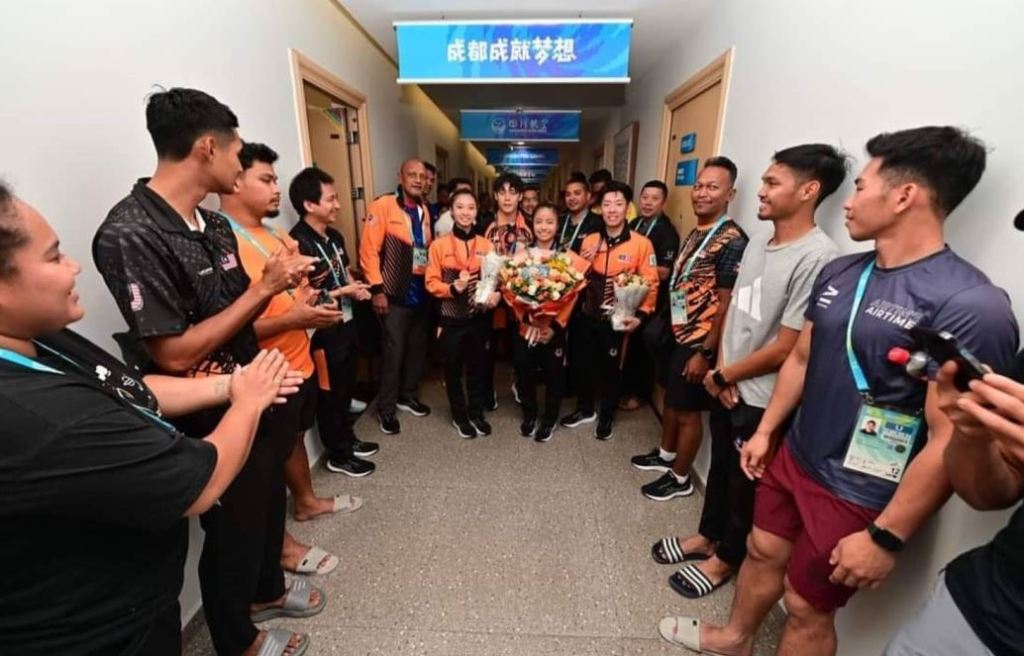
Datuk Dr Pekan Ramli together with the Malaysian contingent and wushu athlete Tammy who made national history by winning the first gold medal at the Universiade Chengdu in 38 years.

Thirty percent of the athletes who represent the country come from the Universities. The existence of a specific policy on sports development at the University level has witnessed a drastic development and since that more than twenty public and private higher education institutions offering more than forty sports study programs from Diploma level to Doctor of Philosophy in fields related to sports science and sports management exists.

This prompted public and private higher education institutions now race to do scouting to get junior athletes and state athletes as well as student athletes from Malaysian sports schools, to offer them the opportunity to continue their studies at the university and at the same time continue to be active in sports.

All this was presented by Datuk Dr Pekan Ramli, the Deputy Under Secretary, Sport Section, Strategic Planning Department (Policy), Ministry of Higher Education in his paper ‘development of sports in universities’.

Pekan, a former broadcast journalist, who is passionate about Universities Sports, strongly believes that the Universities is the way forward to see Malaysian sports reach a higher level at the international level.

But whether the authorities who manage sports in the country see that way or are keen to engage the universities, is a question to be answered.

Infact, besides the sports authorities, National Sports Associations should also engage closely with the universities.

Today, sports has become an integral part of the university system. There are inter-university games, inter-college and higher learning institution games and inter-university leagues for football, hockey, squash and bowling, among others.

University students also compete in the Asean and World Universities Games (currently ongoing in Chengdu, China) and many of our national athletes are products of the universities.

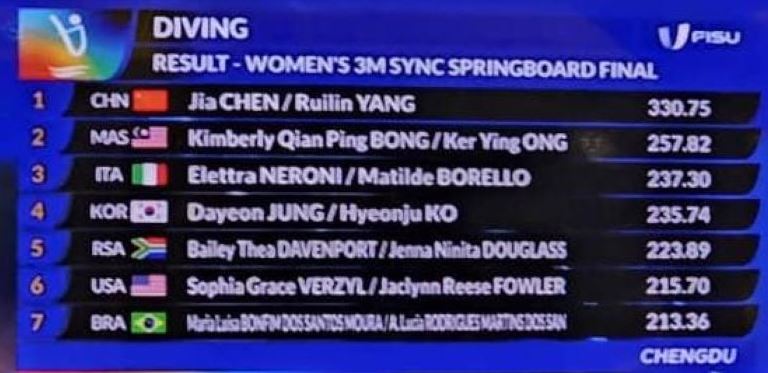
Wushu exponent 22-year-old Tammy Tan created sporting history by winning the country’s first ever gold medal in the World University Games in Chengdu, China, ending a 38-year gold medal drought in the Games, while former gymnast Mandy Cebelle Chen was the first to make podium at the Games winning a bronze in the tajiquan discipline in wushu, while swimmer Bryan Leong and athlete Umar Osman set national records.

Thirteen years ago, then Minister of Higher Education (KPT), Datuk Seri Mohd Khaled Nordin announced that RM10 million was allocated to higher learning institutions under its programme to develop sports among undergraduates.

Sports Excellence Centres at universities nationwide was already in place and the funds allocated was to develop selected sports in a systematic method and provide further education for students athletes in order to create & quot; thinking athletes & quot.

Datuk Dr Pekan Ramli together with the Malaysian contingent and wushu athlete Tammy who made national history by winning the first gold medal at the Universiade Chengdu in 38 years.

Eight universities had already been selected as Sports Excellence Centres which each focusing on a specific sport.

The eight Sports Excellence Centres are Universiti Malaya (netball), Universiti Sains Malaysia (swimming), Universiti Kebangsaan Malaysia (cricket), Universiti Putra Malaysia (rugby), Universiti Teknologi Malaysia (rowing), Universiti Teknologi Mara (football), Universiti Utara Malaysia (golf) and Universiti Malaysia Sabah (taekwondo).

Besides the eight universities, other institutions which had the potential to become centres for sporting excellence had also been given the status of Focus Sport Centre.

There were 18 higher-learning institutions with the Focus Sport Centre status Out of the RM10 million allocated by the ministry for sports development that year, about RM7.2 million was for the Sports Excellence Centres and RM3.6 million for the Focus Sport Centres.

Maybe and update on the status could be given and whether the emphasis has grown.

However, whether a proper study was made before naming the sports to be focused in each particular higher learning institution was made and raised then.iu7 Hope it has been addressed after all these years.

I know for a fact that in 2006 an in-depth study was done by Prof Rabindarjeet Singh who was then with the National Institute of Sports (NSI) on sports adoption by Universities.

A report was complied and it contained the sports to be adopted by the respective University based on the study made which involved available manpower, equipment facilities which were available and what needed to be purchased and manpower to be trained for the University to be effective.

The development of high-performance sports at higher education institutions has seen more and more university athletes now able to represent the country and contribute to the success of the national contingent at regional and international championships.

University athletes representing the country has also been consistently achieved at sporting events such as the Sea Games, Commonwealth Games, Asian Games and the Olympic Games. University athletes are now among the main contributors to the medal collection for the national contingent at various sports games.

To ensure the continued success of athletes and as a strong encouragement to them, KPT also provides sports scholarships for outstanding athletes every year.

Up to now, almost two thousand outstanding university athletes have received the scholarship.

Even some public and private higher education institutions have also given privileges by giving them their own scholarships and exempting student-athletes from tuition fees and college accommodations fees.

Although there is no specific study or empirical study to show the connection between the privileges they receive and the improvement in the performance of these student athletes, MOHE is confident that the success of university student

athletes in various sports games when representing the country has a special correlation with the awarding of the scholarship.

In order to ensure that the careers of student athletes at the university continue and not only active in sports seasonally or once a year during the semester break only, but a massive transformation has also been carried out by the MOHE by creating university level sports tournaments more organized and with systematic manner and running throughout the year.

Various university-level sports tournament has now been held with the concept of ‘NCAA’ by having several circuits and must ended with the grand final along the year for several championship such as Varsity Track and Field, Varsity Sepak Takraw League, Varsity Futsal League, Varsity Softball League and several other sports.

However, the major role played by MOHE and the university in developing the sports higher performance of student athletes as higher education institutions in providing more guaranteed future opportunities for student athletes is still seen as a side character to produce high performance sports athletes in the country.

In fact, the sports development agenda at university is often left out of the sports calendar of National Sports Associations (NSA) and the NSC.

Although various initiatives have been made to close this collaboration, it has not yet been integrated. There is still the conflicts of interests and individual egos in some NSA towards the issue of ownership of the athletes to represent country to participate in university sports games at international level such as Asean University Games (AUG), World University Games or Universiade and World University Championship (WUC).

It is about time, that universities are allowed to play a more prominent role in the national sports agenda.

Universities are no longer the graveyard of sports. A rethink is urgently needed and long over due. One body cannot be handling 20 over sports. 

In fact, the schools have now become the graveyard of sports, and this is another issue which needs to be addressed urgently.

A topic for discussion in the coming columns.

Is it a truly Malaysian Merdeka Day?


Is it a truly Malaysian Merdeka 

Day?

Today as we celebrate our 66th year of independence, I believe we have celebrated better independence days in the earlier years, when we were truly Malaysians celebrating as one Malaysians.

Today, although the nation is considered young compared to many others who had gained their independence longer, the Statistics Department has recorded 2.1 million foreigners working in various sectors in Malaysia up to June 2022.

Close to two million were recorded in 2019 and 2.1 million in 2020, while unofficial estimates of undocumented or irregular migrants range from 1.2 to 3.5 million – thus making Malaysia one of the largest migrant-receiving country in Southeast Asia.

While we are grateful to the foreigners who have helped the nation grow in various sectors, including providing domestic help to the growing population of working parents.

But the question, why is the local population shying away from jobs done by foreign workers?

While generally the unemployment rate in the country has generally dropped – Malaysia’s unemployment rate for 2022 was 3.73%, a 0.32% decline from 2021. Malaysia unemployment rate for 2021 was 4.05%, a 0.49% decline from 2020 – but the rise in foreign workers is alarming.

What is even more disturbing is that sports has seen a sharp increase in foreigners being given citizenship status and the influx of heritage players – a heritage player is one who has ancestral connections with the country that he wishes to play for – especially in football.

While many will claim that sports has no borders these days, but is it right for a young nation like Malaysia to follow the path?

Are we proud to see national teams with foreign players – be it heritage or foreign players granted citizenship – standing looking dumbfounded when the national anthem is played?

It was a delight and I was proud to see the national hockey team – made up of true Malaysian from the length and breath of the country, including East Malaysians – singing the national anthem with pride, passion and gusto.

Malaysia’s population maybe small at 34.3 million, as compared to many nations, but we have the three main groups – Malays, Chinese and Indians – and then we have the Eurasians and Punjabis and the other indigenous groups like Orang Asli, Iban, Murut, Batak, Kelabit, Kedayan Tausug (people ethnic group belonging to both the Philippines and Malaysia) Bidayuh, Kadazan Dusun, Kayan, Penan, Negrito, Minangkabau, Bugis, Kenyah and Javanese to name some.

This is already an international community living in one nation and with such diversity, is it a wonder that our sports fraternity cannot assemble a formidable team with each ethnic group with their strength.

This combination of a mixed team was what brought us glory in sports like football (qualified for two Olympics – Munich and Moscow), badminton (stood tall in Thomas Cup competition), sepak takraw (ruled the region), athletics (qualified on merit to Olympics and even reached the semifinals), and many other sports.

Only the sports of hockey seems to keep to the traditional ways and doing well too.

Being a Malaysian, take a walk to the heart of the city at Petaling Street, Sentral Market and Jalan Silang, today being a public holiday, and you true Malaysians will be the ‘foreigners’ among the sea of Indonesians, Filipinos, Bangladeshis, Pakistanis, Indians, Myanmars, Vietnamese, Cambodians and others.

Is this how we want to remember celebrating our ‘Merdeka Day’. Are we really independent?

We are not denying that the country still need foreign workers in various sectors such as construction, plantation, manufacturing and domestic.

But sports is one area, we can do away with them.

At the same time, we also need to attract locals to work in the plantation or construction industry by providing better facilities so as to reduce the country’s dependence on foreign labour.

We also need to look into the National Sports Policy and a re-look into the National Sports Vision 2030 (VSN2030) launched by (2020) former Sports Minister and then Prime Minister, Datuk Seri Ismail Sabri Yaakob, which was to provide a new direction and plan for the development of national sports that is comprehensively and collectively mapped for a period of 10 years.

Or is this policy still in place because Malaysian sports policies change with every new Sports Minister, as they try to leave behind their own legacy.

How many Sports Ministers have we had in this five-year term?

Besides, the Sports Ministry is also torn between promoting sports for all and paying attention to excellence sports and the National Sports Council also needs to revisit it’s real role in development and promoting sports excellence.

There is lot to be set right for Malaysian sports before it achieves its true potential and today being the ‘Merdeka Day’s, would be a perfect day to start putting things right, with no personal agenda or gain in mind, but for sports to emerge the winners.

Maybe far too much to ask, because we seen the ills rise again over and over, past mistakes repeated and tainted by officials who have personal agendas.

All we can do and pray, is hope things will change in the name of sports and fairplay will prevail. After all, sports is suppose to be pure!

Happy Merdeka Day as we try to live up to this year’s thyme – Tekad Perpaduan, Penuhi Harapan (Determined Unity, Filled with Hope).